Nonprofit surveys ultimate guide (with templates)
Discover how nonprofit surveys can help positively transform an organization, streamlining donor relations, volunteer and funding management, and more.

Nonprofit surveys help organizations stay connected to donors, volunteers, and the communities they serve. They streamline essential work like event planning, relationship management, and program evaluation, making it easier to understand what supporters need and how well your mission is landing.
With SurveyMonkey for Nonprofits, you can use expert-built templates and easy-to-create surveys to improve donor engagement, coordinate volunteers, measure program impact, and support fundraising goals.
This guide walks through how nonprofits can use surveys to strengthen operations and make smarter, data-informed decisions.
Is SurveyMonkey free for nonprofits?
SurveyMonkey offers a free plan that gives you access to some of the best survey tools for nonprofits, making it easy to collect feedback and support day-to-day operations.
What you get on the free plan
The free plan offers a range of features you can take advantage of, including:
- 10 questions per survey: Create custom surveys or use a template with up to 10 questions.
- Expert templates: Leverage years of survey expertise with pre-built survey templates for nonprofits written by survey experts.
- Build with AI: Type in a prompt for a survey, and the AI survey builder rapidly generates a complete draft for you to review and send.
Nonprofit organizations can also choose to upgrade from the free tier to a paid SurveyMonkey plan. Paid plans unlock advanced features and higher limits, helping you get deeper insight into how your volunteers, clients, and donors feel. You can compare options on the plans and pricing page.
How the nonprofit discount works
SurveyMonkey offers significant discounts to eligible nonprofit organizations each year. Nonprofits can review the discount application to see whether they qualify for a lower-rate account.
If you meet all the requirements, you can navigate to the Plans and Pricing page and submit your discount application when you are ready to upgrade. Discounts are available to eligible nonprofits upgrading from a free plan and cannot be applied to existing paid accounts; they are granted at the discretion of SurveyMonkey, typically for limited periods, and availability and discount levels may vary by country.
Grow visibility and donations with SurveyMonkey Contribute
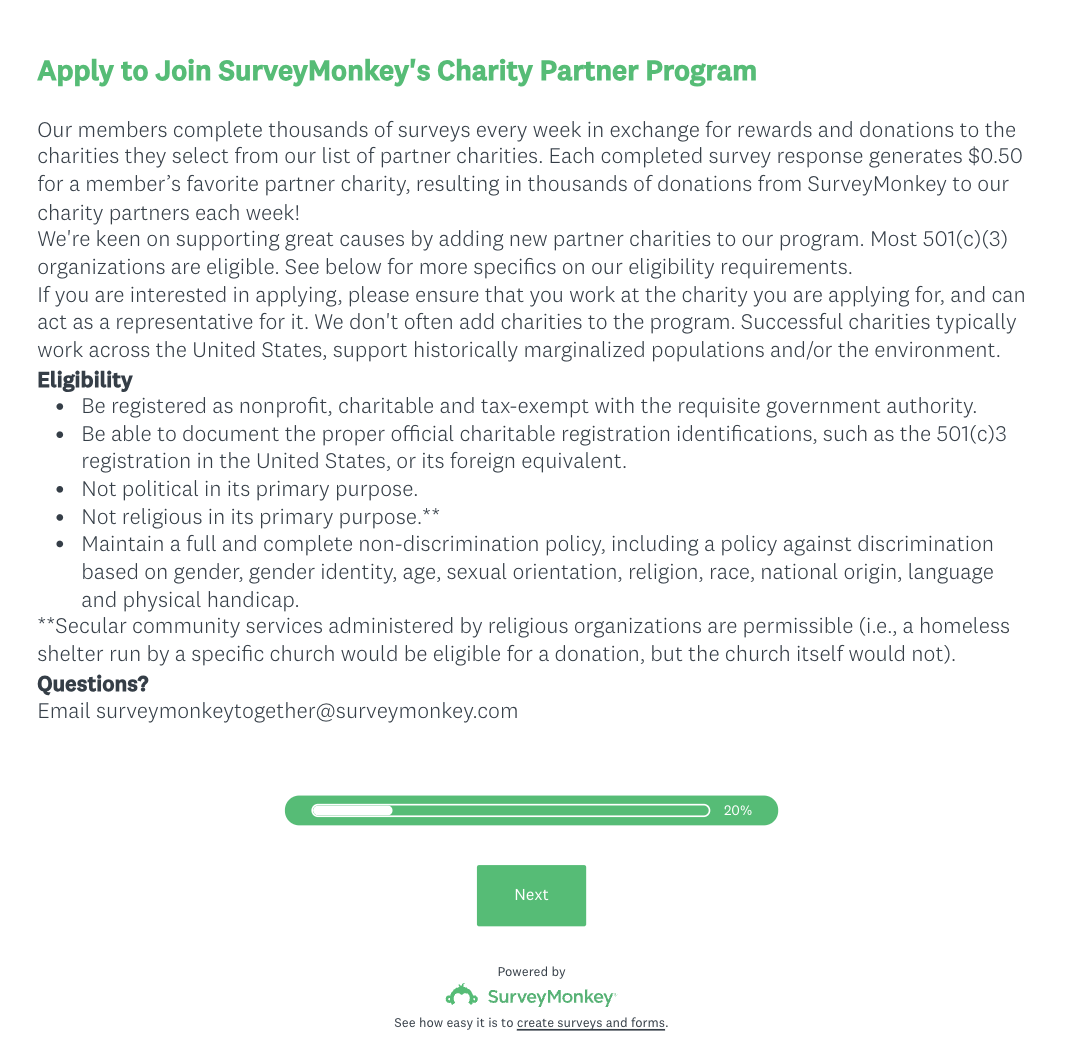
Another powerful way nonprofit organizations can leverage SurveyMonkey is by signing up for the SurveyMonkey Contribute program. With Contribute, participants complete surveys and earn money for participating charities and nonprofit organizations.
Nonprofits can partner with SurveyMonkey Contribute to generate exposure and gain donations—join to nominate your charity so participants can direct their Contribute earnings to your organization. To register for this program, your nonprofit must:
- Be registered as a nonprofit.
- Provide sufficient documentation of charitable registration.
- Not be political or religious in purpose.
- Maintain a full non-discrimination policy.
SurveyMonkey Contribute is only available in the United States and is not available in every state. Residents of certain states are not eligible to participate, so you should confirm availability where your supporters live before you promote the program.
What are the best surveys for nonprofits to use?
Surveys for nonprofit organizations are structured questionnaires that collect feedback from donors, volunteers, employees, and community members to guide program, fundraising, and operational decisions. They help organizations see what’s working, identify areas that need attention, and prioritize where limited time and resources will have the greatest impact.
Let’s explore some of the best nonprofit survey templates and example survey questions to use across your organization.
Fundraising and donor feedback
Fundraising and donor feedback surveys allow nonprofits to check in with donors and gather feedback after campaigns or fundraising events, helping them strengthen relationships and grow lifetime value.
Here's how to use a donor feedback survey:
- Improve donor relations: Collect feedback from donors and discover how to improve their experience with your nonprofit.
- Enhance events: Send the survey after an event to identify what worked well and what you can improve next time.
- Scope understanding: Gauge how well donors understand your fundraising objectives and mission.

Sample questions to ask donors
- How much of an impact do you feel your donation makes?
- How easy or difficult was the process of donating to our organization?
- How well did our organization explain how your donation will be spent?
Use the Donor Feedback Survey Template to collect this input quickly and consistently.
Event planning and feedback
Event planning and feedback surveys are an excellent way to understand your donors and supporters better and discover what they’re looking for in an event, both before and after it happens.
Here’s how you can use an event feedback survey template:
- Identify preferred event type: Ask donors what types of events (galas, interactive evenings, virtual town halls, and more) they’d like to attend.
- Solicit post-event feedback: After an event, measure how successful it was and what donors would like to see improved in the future.
- Logistics planning: Use an event planning survey to learn when donors are free, how long the event should last, and other logistical details.
Sample questions to ask about events
- How likely is it that you would recommend the event to a friend or colleague?
- What topics would you most like to learn about or discuss at this event?
- Do you have any dietary restrictions?
Use event feedback and planning survey templates to standardize your nonprofit survey questions and compare results across events.
Nonprofit operations and employee experience
Nonprofits rely on networks of employees and volunteers to keep their organizations running. Requesting feedback from these groups helps you create the best possible employee and volunteer experience, track burnout, and support a more inclusive culture.
Here’s how you can use employee and volunteer feedback surveys:
- Evaluate the employee experience: Monitor the employee experience and identify actions that can create a better workplace.
- Organize volunteer hours: Make it easy to collect availability from volunteers for specific events or shifts.
- Build better training programs: Ask volunteers and staff how effective training was and where you can improve.

Sample questions to ask staff and volunteers
- How much of an impact do you feel your volunteer had?
- How convenient were the volunteer training sessions at our organization?
- Overall, were you satisfied or dissatisfied with your volunteer experience with our organization?
Use employee engagement survey templates alongside the Volunteer Feedback Survey Template to capture staff pulse, DEI insights, and indicators of burnout.
Volunteer recruiting and management
A constant influx of new volunteers helps your nonprofit run programs, manage events, and build donor relationships. Volunteer recruiting and management surveys make it easier to match people to the right roles and keep them engaged.
Here are a few reasons you should use volunteer recruiting surveys:
- Collect applicant data: Keep volunteer applications in one place for easier program and HR management.
- Streamline selection: Filter survey responses to identify top candidates with minimal effort.
- Discover skills: Capture specific skills and interests to align volunteers with the right opportunities.
Sample questions to ask prospective volunteers
- How many hours per week would you like to volunteer?
- What kind of volunteer jobs are you interested in?
- What skills do you have?
Use our Volunteer Application Form Template to standardize your volunteer recruiting pipeline.
Nonprofit marketing
Market research surveys help nonprofits understand their broader audience, identify useful donor and supporter segments, and refine campaigns to reach the right people with the right message.
Here’s how you can use market research surveys as a nonprofit:
- Collect demographic data: Discover the core demographics of your ideal donor so you can create tailored campaigns for high-value segments.
- Improve marketing strategies: Identify the marketing channels and methods that best resonate with your audience.
- Competitor research: Conduct basic competitor research to see how similar nonprofits show up in the market and identify gaps you can fill.

Sample questions to ask your audience
- Which of the following best describes your relationship with our organization?
- How did you first hear about our organization?
- Which communication channels do you prefer for hearing from us?
To reach people beyond your existing list, combine these surveys with SurveyMonkey Audience to target specific supporter profiles and test messages at scale.
How to do market research for a nonprofit
Market research helps nonprofits understand the donors, volunteers, and communities they aim to serve. By mapping audience needs, motivations, and barriers, you can design programs that resonate with audiences, strengthen fundraising campaigns, and reach the people most likely to support your mission.

Here’s a step-by-step approach to help your nonprofit conduct market research:
1. Define your audience and goal
Decide who you need to hear from (for example, current donors, lapsed donors, volunteers, program participants, or the broader community) and what decision the research will inform, such as refining your message, testing a new program, or understanding donor churn.
2. Form a clear hypothesis
Write down what you think is happening and what you want to test, for example, “Lapsed donors stopped giving because they don’t see enough impact updates,” or “Younger supporters prefer text and social media over email.”
3. Reach out to donors and supporters
Contact one-time or past donors who have stopped contributing to understand donor churn. Ask why they stopped giving, what might encourage them to re-engage, and how they prefer to hear from you so you can prevent future churn.
4. Recruit respondents (including beyond your list)
To reach people beyond your existing contact list, start by identifying the demographics, locations, or interest groups you want to learn from. Once you know whom you need to hear from, you can use tools like SurveyMonkey Audience to recruit those respondents and understand what drives them to donate and engage.
5. Segment your approach
What works for one segment may fall short for another. Segment your donors and community (for example, by age, giving level, geography, or engagement history) and use different marketing tactics to engage each group. Use surveys to discover what different audiences are looking for in your nonprofit.
6. Field the survey and collect responses
Launch your survey using a market research or nonprofit template, keep it focused and concise, and monitor response rates to send reminders if needed.
7. Analyze findings and identify actions
Look for patterns across segments, such as which messages resonate most, which channels perform best, and common reasons for churn. Use these insights to refine campaigns, donor journeys, and volunteer outreach.
8. Improve your nonprofit branding and share results
Use what you learn to update your nonprofit branding so it is more relatable to your target audience. Share key findings—and how you’ll act on them—with staff, board members, and, when appropriate, donors and community partners to build trust and alignment.
How to measure nonprofit success
Measuring nonprofit success means tracking the health of your relationships with donors, volunteers, employees, and the communities you serve. Surveys give you a consistent way to benchmark those relationships, understand what’s improving or slipping, and make decisions rooted in real feedback rather than assumptions. By pairing operational metrics with survey data, you can see how well your outreach, programs, and fundraising efforts are working over time.
For example, you can leverage the following nonprofit metrics to measure your success over time:
- Net Promoter Score® (NPS): The NPS is a general metric that suggests how loyal your donors are to your business. By measuring and benchmarking it over time, you can monitor customer loyalty and demonstrate how you’re improving your donors' experience.
- eNPS: If your employees are happy, your donors will be too. Survey your employees regularly to discover ways you could enhance their experience. You can boost employee satisfaction and drive employee loyalty by responding to their feedback.
- Donor retention rate: A low donor retention rate could suggest your message isn’t strong enough to keep donors interested over time. By measuring your donor retention rate and surveying current and past donors, you can pinpoint methods to enhance your retention rate and decrease churn.

In addition to these survey-based nonprofit success metrics, it helps to organize your KPIs by outcome area:
- Fundraising: Track donor retention rate, average gift size, and a simple donor lifetime value (CLV) proxy (average gift × average gifts per year × average years retained). These indicators reveal how effectively you’re building long-term donor relationships.
- Volunteers: Monitor volunteer retention, total hours contributed, and volunteer satisfaction through short pulse or eNPS-style questions. Together, these metrics show whether volunteers feel valued and want to stay involved.
- Programs: Define a focused set of outcome indicators for each program—skills gained, behaviors changed, or needs met—and pair them with beneficiary satisfaction scores from post-program surveys. This combination helps demonstrate impact to funders and improve services using lived experience.
- Events: Track attendance (registrations vs. actual turnout), post-event NPS or satisfaction, and conversion metrics, such as how many attendees become donors, volunteers, or program participants. These data points show whether your events are driving meaningful engagement.
Turn survey responses into a clear impact report
Once responses are collected, SurveyMonkey Analyze tools help you turn raw data into a clear nonprofit impact story. In the Analyze results section, you can filter and compare responses, build charts, and export results in formats often requested by boards and grantmakers—CSV, XLS, PDF, PPT, or SPSS.
To support confident decision-making, you can also use resources like the sample size calculator and margin of error calculator to check whether your results are statistically reliable before sharing them.
20+ tips for running NPO surveys
Running effective nonprofit surveys starts with clear goals and solid survey best practices. Use this checklist to collect reliable feedback you can turn into meaningful insights.
Plan with the end in mind
- Define objectives: Before sending out a survey, clearly define the decision you’ll make with the results (for example, adjust a campaign, refine a program, or update volunteer onboarding). Map each decision to 1–2 must-have questions.
- Set success metrics: Decide how you’ll measure success up front—such as donor retention lift, average gift increase, volunteer hours contributed, or improvements in satisfaction scores.
Sampling & recruitment
- Choose your audience: Identify who you need to hear from (donors, volunteers, beneficiaries, event attendees, staff, or community members).
- Use the right recruitment method: Reach people via your contact lists (email, SMS, social) or use SurveyMonkey Audience when you need net-new reach outside your existing supporters.
- Note incentives and eligibility: Be clear about who should respond and whether you’re offering a small, ethical incentive (for example, an optional raffle) to thank participants for their time.
Write bias-free questions
- Keep surveys short: Reduce the number of questions so respondents can finish in about 5–10 minutes.
- One idea per question: Avoid “double-barreled” questions that ask two things at once.
- Use balanced scales and plain language: Offer answer options that cover the full range (for example, from “very dissatisfied” to “very satisfied”) and avoid jargon.
- Mix closed and open-ended questions: While one or two open-ended questions are useful for depth, most of your survey should be close-ended so you can analyze results quickly.
Accessibility & participant care
- Make surveys accessible: Use clear headings, simple layouts, and question text that works with screen readers.
- Provide progress indicators: Show participants how far along they are to reduce drop-off.
- Offer anonymity options: When appropriate, let respondents answer anonymously or skip sensitive questions.
- Explain data use and consent: Briefly state how you’ll use responses, how long you’ll keep them, and how you protect data; avoid collecting personally identifiable information (PII) you don’t truly need. Link to your privacy or trust center for more detail.
Fielding & timing
- Send at natural moments: Launch surveys right after meaningful interactions, such as post-donation, post-event, after a volunteer shift, or at quarter-end for staff pulses.
- Be thoughtful with reminders: Limit reminders to two or three, vary subject lines, and respect quiet hours and time zones to avoid survey fatigue.
Boost response rates
- Personalize intros: Use clear, friendly introductions that reference the relationship (“As a recent donor…” or “As a volunteer in our last event…”).
- Set expectations: Tell people how long the survey will take and why their feedback matters.
- Design mobile-first: Keep nonprofit survey questions concise, avoid heavy images, and test on mobile so supporters can respond on any device.
- Consider small incentives: When appropriate, use small, ethical incentives such as raffles or swag to thank participants—especially for longer or more complex surveys.
Analyze, share, and act
- Analyze after closure: Wait until you have enough responses, or close the survey, before drawing conclusions.
- Segment your results: Break down responses by role (donor vs. volunteer), recency of engagement, or program to uncover meaningful differences.
- Export and share: Export results (for example, to XLS or PDF) for board packets, grant reports, or presentations, and highlight 3–5 key takeaways plus actions.
- Close the loop: Share a brief “You said, we did” update so respondents see how their feedback led to changes.
Data governance & retention
- Store responses in approved systems: Keep survey data in secure, approved tools rather than spreadsheets scattered across inboxes.
- Set retention windows: Decide how long you’ll keep different types of survey data and document your retention schedule.
- Restrict access by role: Limit access to sensitive data to only the staff who need it to do their work.
- Document changes over time: When you repeat a survey, record any wording or scale changes so you can interpret trends accurately and explain them to leaders, auditors, or funders.
Related reading: Using surveys to measure and amplify impact

Nonprofit survey use cases and real-world examples
SurveyMonkey is a firm believer that nonprofits can change the world. Over recent years, we’ve had the pleasure of working with nonprofits from around the globe that are delivering a profound social impact.
Let’s explore examples of how nonprofits use surveys to enhance their organizations.
Connecting families with affordable child card
The Early Learning Coalition of Northwest Florida (ELCNWF) is a nonprofit that supports low-income families by funding childcare assistance. The organization has worked with over 3,500 families and helped over 5,000 children access education.
The ELCNWF uses surveys to streamline administrative tasks, helping with grant applications and provider feedback. As ELCNWF doesn’t have active data scientists in its organization, SurveyMonkey’s Analyze tools help them make sense of their data.
Across customer satisfaction, employee engagement, and employee satisfaction, ELCNWF uses SurveyMonkey’s features and templates to drive engagement, enhance their processes, and bring them one step closer to supporting families in need.
Testing a new nonprofit product concept
Vanguard Charitable sponsors donor-advised funds, with thousands of charitable donors in their network. After the pandemic, Vanguard wanted to survey donors to see how they would most like to allocate their giving efforts. By leveraging SurveyMonkey, Vanguard discovered that donors wanted to get hyper-local with their donations but didn’t have information on any local nonprofits to support.
The team at Vanguard began concept testing a product with SurveyMonkey Product Concept Analysis, developing the Nonprofit Aid Visualizer. After rounds of successful testing, Vanguard launched the product, allowing donors to locate local organizations that are important to them quickly.
Using SurveyMonkey, Vanguard gathered over 1,000 survey responses to their product testing, allowing the company to streamline product development and bring it to market as quickly as possible. Since its launch, the Nonprofit Aid Visualizer, in tandem with Vanguard Charitable, has generated donations that exceeded $1.5 billion in 2020.
Strengthen your nonprofit with SurveyMonkey
SurveyMonkey offers intuitive features and templates that help nonprofits succeed. From developing new offerings to organizing events, SurveyMonkey templates help you collect and analyze data quickly so you can move faster from insight to action.
Nonprofits rely on SurveyMonkey to increase donations, strengthen operations, and generate clear market research insights.
Get started today with SurveyMonkey for nonprofits, and if you are eligible, apply for a nonprofit discount.
Ready to get started?
NPS, Net Promoter & Net Promoter Score are registered trademarks of Satmetrix Systems, Inc., Bain & Company and Fred Reichheld.