
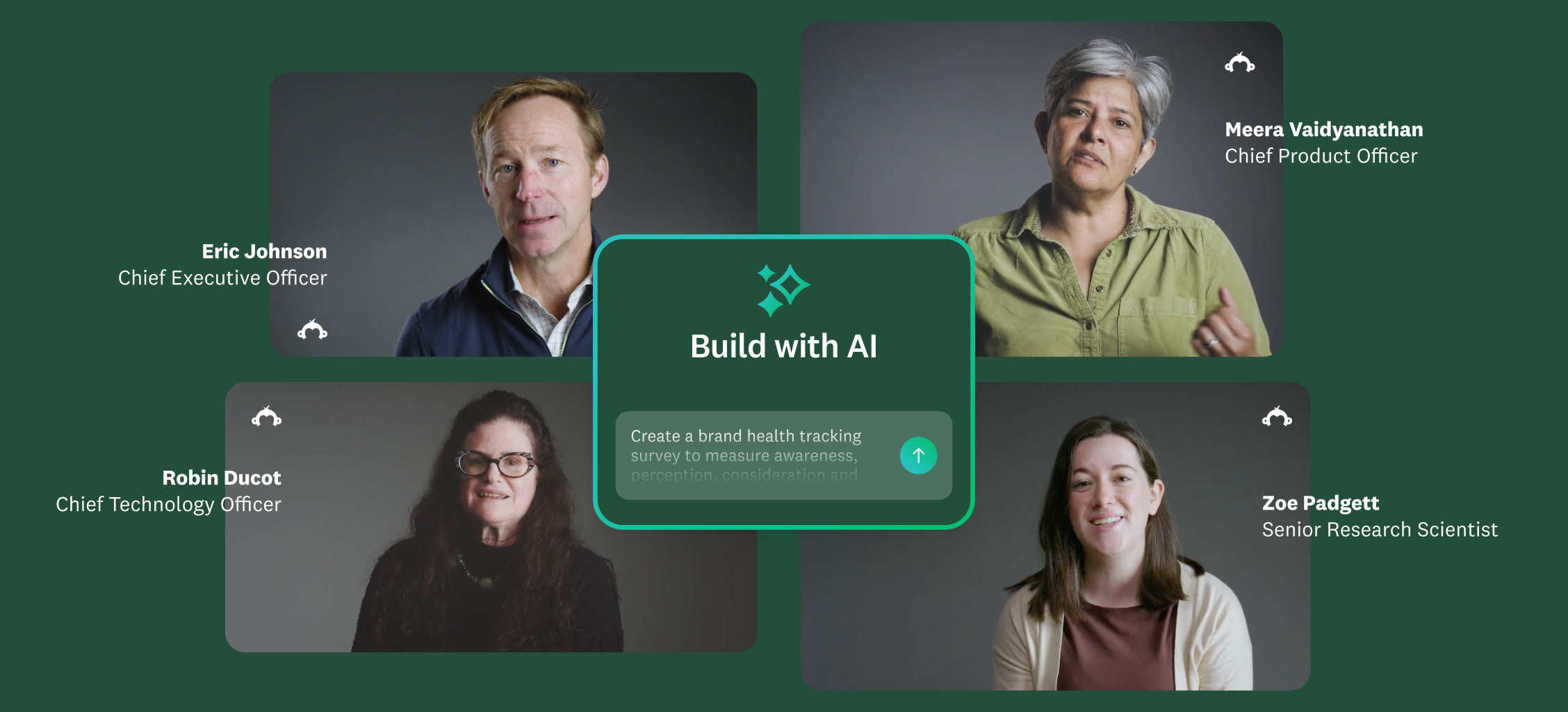
AI is now table stakes. Trust is not.
At SurveyMonkey, we’re focused on building AI features that make it easy to ask better questions, surface deeper human insights, and trust the answers you get back. Our goal is to empower people—not replace them.
Here’s a look behind the scenes at how our teams think about SurveyMonkey AI and why responsible, insight-driven design matters more than hype.
SurveyMonkey is the world’s most popular survey platform, with more than one billion questions asked. So where does AI fit in?
Meera Vaidyanathan, chief product officer
We’ve been building AI into our product for many quarters now, and it’s critical to our product strategy. On the survey creation side, it’s helping people frame the right questions, the right way. And on the analysis end, it’s helping them glean the best insights so they can move their business forward.
Of course, everything in product development starts with what the customer needs—and AI is no different. Customers want to get results in an efficient, effective, and expedient way. They want to be able to act. That’s always top of mind as our team brings our AI features to life.
Many companies are racing to ship AI. How do we make sure our innovation is intentional, not just reactive?
Meera Vaidyanathan, chief product officer:
With any company’s product roadmap, there’s always too many things to do and not enough time. As our team evaluates our own roadmaps on a quarterly and annual basis, we think about where SurveyMonkey AI and machine learning capabilities can be most useful to our customers. We’re focused on outcomes, as opposed to knocking off a long list of features that aren’t truly tied to benefits for our customers.
Eric Johnson, chief executive officer:
Balancing speed with responsible innovation is our priority, but the goal is simple: building AI that makes our customers’ lives easier. We are ambitious about the pace of change while remaining deeply thoughtful about the human experience. Our teams are focused on AI that makes our platform simple to use, the survey creation process intuitive, and analysis interesting. Ultimately, we aren't just following where AI takes us; we are empowering our users to decide where they want us to take AI.
How does SurveyMonkey build accuracy, reliability, and best practices into its AI?
Robin Ducot, chief technology officer:
Reliability and accuracy are huge for us—because otherwise, what are we doing?
With our AI features and machine learning solutions, we continuously monitor output and follow best practices to maintain validity. We periodically retrain and compare prediction accuracy against the ground truth, otherwise known as known data. That allows us to assess quality and make adjustments when necessary to ensure our customers can rely on their data.
Zoe Padgett, senior research scientist:
When we started developing Build with AI, I collaborated directly with our engineering team. I have a master's degree in survey methodology, and I used everything I learned in my program to inform our product.
I created a checklist of well-established survey methodology best practices—things like making sure the response scales match the question, avoiding double-barreled questions, and optimizing question order. That checklist was vital as the AI team iterated on our feature, and anytime we make a big change to the models or prompts, I make sure nothing deviates from those best practices.
We also constantly evaluate our expertise. One of my colleagues on our product research team recently interviewed internal and external survey experts to make sure that we're following the most up-to-date practices in the field of survey research. Those insights guide our processes and help us identify gaps and areas for improvement.
Meera Vaidyanathan, chief product officer:
Trust is really the backbone of everything we do, and it’s why people continue to come to us to get the best insights out of their surveys. Transparency is key. Our customers need to know when we’re using AI, how our models are trained, and what data is used to train them. We want them to understand not only how their data may or may not be used, but also how we arrive at the insights that we give them.
And as always in software, it’s important to give customers the controls, should they want to turn AI support on or off.
From your perspective, what’s an immediate benefit someone could get from SurveyMonkey AI?
Zoe Padgett, senior research scientist:
I think that our response quality feature is so cool, and really easy to use. You can just toggle it on, and it filters out poor-quality responses automatically. The SurveyMonkey research team uses it a lot as we conduct our original research and reports, and it improves our data quality and saves us a lot of time.
Eric Johnson, chief executive officer:
Analyze with AI allows me to take hundreds or thousands of survey responses and turn them into something I can take action on. I can understand overall sentiments easier, and see what themes are arising over time.
Meera Vaidyanathan, chief product officer:
The biggest hurdle for a lot of people is just getting started. If you aren't an expert in survey research or survey design, that is where our AI capabilities can really shine. Crafting the perfect survey question is an art and a science, and our AI makes it easy to get it right on the first try. That way, you know you’re set up to get the best responses.
Robin Ducot, chief technology officer:
Our AI gives you a head start by automatically applying the lessons we’ve learned from billions of real survey responses. What sets SurveyMonkey apart is that we sit on a goldmine of response data across industries. Our algorithms have the benefit of 26 years’ worth of real data and experience with surveys. We're able to use that proprietary data set to train models to understand survey design best practices, predict response quality, and generate industry-specific benchmarks. Essentially, we’re using our history to make sure you get high-quality, professional results right out of the gate.
Learn more about our SurveyMonkey AI and see how it can help you create high-quality surveys and spot trends faster.


