
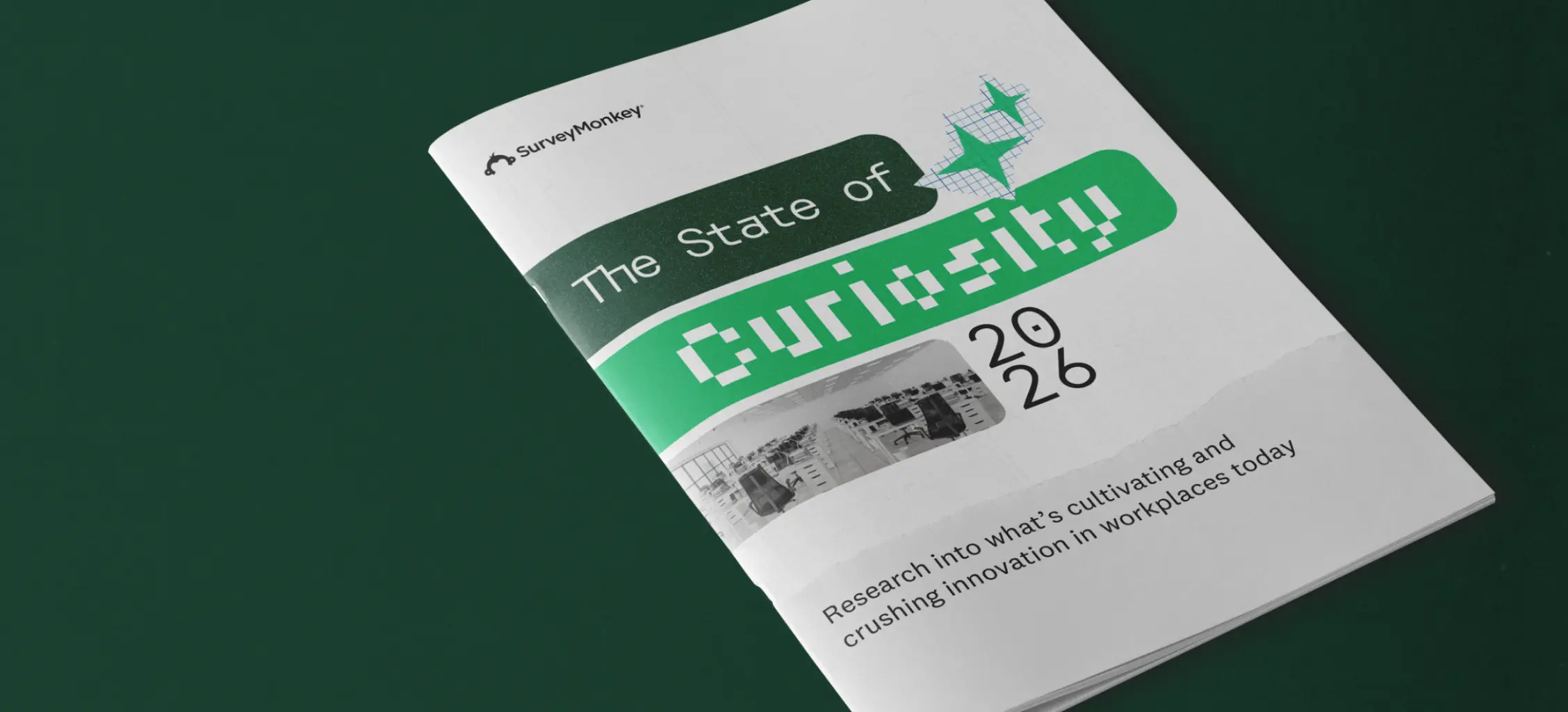
Curiosity is alive and well in workers, but our workplaces are smothering it.
This State of Curiosity report captures how workers and leaders are feeling about their own personal curiosity and reveals the curiosity barriers workplaces create. Based on a survey of 1,925 workers, SurveyMonkey discovered that the vast majority of employees describe themselves as curious, and six in ten identify as strongly so. But only three in ten say their workplace strongly rewards curiosity. This tells us that curiosity—a vital prerequisite to all innovation at work—is in the workforce, but the way we work today is suppressing it.
That gap costs more than it used to. AI has shifted what employers measure and the output a worker produces no longer signals who is doing the thinking. Anyone with a chatbot can hand in a polished deliverable. Evaluation is moving upstream, to the inputs: the questions a worker asks, the assumptions they push on, and what they noticed that the machine missed.
Curiosity capacity, the practiced ability to stay open, ask sharper questions, and keep learning alongside AI, is the input that does the most work.
Three forces are draining worker curiosity:
- The AI middleman: Leaders are running questions by machines instead of by their teams at nearly three times the rate of the workers below them. The conversations that used to build judgment across an organization are being replaced by prompts, and the cost is showing up later in preventable mistakes.
- The scroll reflex: Workers spend hours a day in social media feeds engineered to serve up the next thing and keep them scrolling, and the habit follows them to the desk. More than a third of workers now accept whatever AI produces without pushing back. They say asking a colleague is more reliable than AI, but they take what AI gives them anyway.
- The efficiency squeeze: Speed is what management rewards, and it's left no time in the workday to be curious. The result is a workforce that has learned to stop asking the questions that would push thinking and catch problems earlier.
These three forces don't just smother curiosity. They blur what workers think curiosity even is. Most call themselves curious, but four in ten admit to pretending they understood something rather than ask the question that would have exposed they didn't.
The youngest workers are paying the highest price. Gen Z workers report the most pressure to already know the answer, the highest rates of pretending to understand, and the steepest drop in asking questions of colleagues. The conditions for asking have gotten worse, and Gen Z is responding rationally to them.
The good news is the same as the bad: workplaces created this and can change it. Certain employers are already showing how to design curiosity back into the workday, and their playbook is one any leader can act on tomorrow.
This report is a guide to building curiosity capacity—and a measure of what it costs employers when they don't.
State of Curiosity: The PDF
Keep these curiosity insights within reach. Download the report for easy reading and sharing.
Why curiosity is your single greatest competitive advantage
For most of professional history, workers have been measured by what they produce. The output was a reasonable proxy for the thinking, but AI has broken that proxy. What now matters is the question a worker asks, how hard they push on the assumption underneath it, and what they notice that the machine missed.
The thinking is the job now. Employers are responding by changing their hiring priorities and analytical thinking is now the #1 core skill employers seek, while curiosity will be among the fastest-rising skills from now until 2030, according to the World Economic Forum.
A separate global survey of executives identified the same gap from a different angle: AI is automating the entry-level work where workers typically develop expertise. The result is that HR now has to redesign roles around what AI can't do. In this new model, curiosity capacity is the most valuable input a person brings to the job.
Curious workers push past a first answer. They keep asking when the rest of the room has moved on, and they're the ones most likely to catch the assumption before it hardens into strategy. This skill matters more in a moment when AI produces confident answers nobody is interrogating.
Recent research from Carnegie Mellon University, Swiss Business School, and MIT has converged on the same finding: frequent AI users show measurable declines in critical thinking, with cognitive effort offloaded to the tool. Workers who use AI to extend their thinking—not substitute for it—do the work that compounds.
The gap a single leadership behavior creates
Workers in high-curiosity-capacity cultures¹—places where leaders encourage them to ask questions—describe a working environment that looks nothing like the one their low-capacity peers describe. They feel safe asking questions at more than twice the rate. They explore new ideas in meetings more than three times as often. They report meaningfully less of the wasted time, redo work, and missed opportunities that drain organizational performance.

What even is “curiosity” at work?
Curiosity is often defined in academic literature as the intrinsic pull to close an information gap. It can be fast and intuitive, and often an end in itself: you feel a question, you want the answer, and the wanting is the mechanism. That definition matters because it's not what most workplaces mean when they say they want curious employees, said Jack Soll, a distinguished Professor of Management and Organizations at Duke’s Fuqua School of Business. Workplaces mean exploration, risk-taking, building, asking sharper questions of each other, and sitting in not-knowing long enough to find a better answer. Those are different motivations stacked on top of curiosity. Curiosity is the spark, but the rest is what an organization does with it.
The real difference between low and high curiosity workers
Conventional wisdom may lead many to believe that uncurious workers have given up: they don't care about the work or take pride in it. Our data say otherwise. Workers across the curiosity spectrum are nearly equally likely to find their work meaningful and take pride in what they produce.
What separates them is what happens next: high-curiosity workers take on challenging work at almost three times the rate of their low-curiosity peers. They're more likely to be recognized for it. And they're twice as likely to say they're advancing at the pace they want. This may be because curiosity drives self-efficacy, a person's belief that they can accomplish the task at hand. The more curious a person presents, the more time they spend on a given task and the more resilient they are in the face of adversity.
The three forces draining curiosity capacity
Curiosity may be the greatest competitive advantage for the workplace of the future. And yet, three powerful forces are draining curiosity capacity across our organizations.
These forces come together to create a workplace that is deeply uncurious. But each force is a choice—and each choice is reversible.
1. The AI middleman
The people who have the most to lose from the curiosity drain are the ones who built it. Leaders—defined here as directors and above—are routing their questions through AI at nearly three times the rate of individual contributors (ICs). Half of ICs say they never use AI in place of a teammate; among leaders, it's closer to one in five. The workers with the most colleagues to call are the ones least likely to call them.

Leaders may be trying to use AI to make work more efficient: AI is fast and talking it through is slow. But workers who frequently use AI in place of a colleague are far more likely to report a problem such as redoing the work, missing an opportunity, or falling out of sync with the rest of the team. Across every problem the survey measured, the more workers leaned on AI, the more often something went wrong. AI is making the work quicker to begin and slower to finish.
“AI allows us to impersonate leadership without doing the hard work of actually leading.”
-Anne Morriss, founder of The Leadership Consortium
AI closes information gaps in seconds, which satisfies the curiosity impulse immediately—and stops there. Workers describe gap-closing as curiosity, but without follow-through to get to deeper understanding, it isn't.

When you reach for AI matters just as much as how. Workers who partially solve a problem before consulting AI outperform those who reach for AI first, according to research from the University of Chicago.
2. The scroll reflex
The scroll reflex is what online culture trains into a worker: take what's served and don't go looking for more. Social media feeds are built to keep you scrolling. In the workplace, this reflex shows up as a preference for the first decent answer over the right one.
“Once you get an answer from AI, it feels as if it's complete and there's nothing more to know.”
-Jack Soll, a distinguished Professor of Management and Organizations at Duke’s Fuqua School of Business
More than a third of workers who use AI accept whatever the model produces as-is, or do a quick check and move on. The strange part is that the same workers, by their own account, don't particularly trust AI. Most say a colleague is more reliable than the model.

The same narrow idea, served up over and over
When workers use AI to help them think, the thinking starts to look the same. In a study of AI-generated versus human-generated thinking, nearly every idea from a human working alone was unique—and nearly none of the ideas from a human working with AI were. The platforms most workers spend their off-hours on are built to keep them engaged. That engineering shows up at the desk: even small AI nudges like autocomplete and predictive text flatten the words people choose. The scroll reflex narrows the field of possible answers before the worker has had a chance to see how wide it was.
“AI might make us individually smarter…but the opposing force is going to make us all the same, which might make it harder to be creative and to be innovative.”
-Jack Soll, a distinguished Professor of Management and Organizations at Duke’s Fuqua School of Business
3. The efficiency squeeze
The efficiency squeeze is what happens when speed becomes something management rewards. The time curiosity needs—to notice what's missing, find someone who might know, come back with a better question—has been engineered out of the workday. More than half of workers say more unstructured time would help them be more curious. They know what's broken; the workplace just hasn't given it back.
The place this shows up most reliably is in meetings. Only 38% of workers describe most of their meetings as open discussion and idea exploration. The rest are status updates, and information transfers that could have been an email. Among workers in low-capacity cultures², the share of meetings that count as open discussion drops to 15%, and more than half say they rarely or never explore new ideas there. Meetings are where curiosity capacity is spent or saved, and in most workplaces it is being spent on the wrong thing.

The cost of this squeeze shows up after the meeting ends. Half of workers have had to redo work because questions weren't asked at the start. Nearly as many have watched time and money disappear into assumptions nobody pressure-tested.
Interrupted workers can't be curious workers
The average knowledge worker is interrupted every two minutes—about 275 times a day, according to Microsoft's 2025 Work Trend Index. The cost compounds: a separate report suggests it can take between one and 23 minutes to regain focus after a single interruption.
A majority of the workday goes into communication, according to Microsoft, leaving not enough time for workers to do their jobs well: Eighty percent of workers said they don't have the time or energy to do their jobs effectively. And nearly half of knowledge workers say they don't have enough time for creative work, while only 8% regularly propose new ideas, a study by Dropbox discovered.
The smothering of the next generation
The curiosity drain spans every generation, but it cuts deepest among the youngest workers.
Young workers are watching leaders route questions through AI. When they follow suit, they lose out on essential opportunities for growth. Early-career workers build judgment by asking colleagues questions in real time and getting pushback. A worker who routes those questions to a chatbot gets an answer and loses the apprenticeship.
Across three separate measures of workplace masking—pretending to understand something they don't, feeling pressure to already know the answer, and staying silent because they've already asked too many questions—younger workers report the highest rates and Boomers report the lowest. And yet, younger workers are also the most likely to say curiosity is rewarded more now than it used to be: 42% of Gen Z describes their workplaces as more rewarding of curiosity than it was five years ago compared to 23% of Boomers.
“Young workers really need to know how to influence, how to manage up, how to operate within the social environment of the organization. In order to do that, you have to have social interaction.”
- Jack Soll, a distinguished Professor of Management and Organizations at Duke’s Fuqua School of Business
This contradiction resolves itself once you consider how curiosity is rewarded in the workplace. When a VP asks a basic question in a meeting, it gets read as engagement. When an associate asks the same question, it gets read as unpreparedness. Senior leaders spend decades building the credibility that makes not-knowing safe. Their curiosity is backed by capital. Early-career workers haven't banked that credibility yet, and they know it.

The AI-native generation is also the AI-resistant generation
Gen Z's relationship with AI at work is more complicated than the AI-native label suggests. A recent survey of knowledge workers found that 44% of Gen Z workers admit to actively sabotaging their company's AI strategy—entering proprietary data into public tools, using unapproved software, generating deliberately poor outputs, or refusing the tools entirely. The same survey found that 80% of Gen Z trust AI more than their manager for at least some work tasks.
The picture that emerges is of a generation moving in two directions at once. Gen Z workers are sabotaging AI rollouts they don't trust, and at the same time turning away from the human relationships that would normally help them grow. Both moves are responses to the same underlying condition: a workplace that hasn't given them solid ground to stand on.
What curiosity looks like in action
Curiosity capacity is the practiced ability to stay open, ask sharper questions, and keep learning alongside AI—especially when it would be easier to lean on what you, or the machine, already knows.
Two SurveyMonkey customers and one in-house example show what each of those muscles looks like when an organization actually uses it.
Stay open
Yu-Ai Kai, a Japanese American senior community center in San Jose, California, closed during the pandemic after running programming for more than 50 years. Executive Director Jen Masuda described the moment as a reset and the question her team asked as they prepared to re-open—how do we do this now?—is the exact question most organizations skip when they rush back to old habits.
Yu-Ai Kai's answer was to gather data on who its current members actually were, what they wanted, and what would draw in the younger seniors and male seniors it was losing. Hundreds of survey responses turned into something staff and board members could understand and act on, moving the conversation from “what is the issue?” to “here are the potential solutions.”
Curiosity in action
The next time your team is coming back from a pause—a reorg, a launch cycle, a return from leave, a post-mortem, a new fiscal year—don't assume the people, problem, or market are the same as when you left. Pick one program, process, or customer segment you've been running on muscle memory and ask the people who live inside it:
- What's changed since we built this?
- What do you need from it now?
- What would you stop doing if it were up to you?
Actually read the answers. The discipline is asking the questions before something forces you to.
Ask sharper questions
Art supplier Sakura has been in business for more than a century. Its American affiliate (Sakura of America) had aggressive growth targets and a problem familiar to any multinational: the company's R&D lived in Japan, but its North American buyers weren't all Japanese.
Senior Marketing Manager of Innovation and Consumer Insights Casey Singh's job was to close the gap, and she did it by asking more questions. When she suspected US consumers would consider a $100 pen too expensive, she tested it instead of arguing it. The data confirmed the hunch. The move from “we don't think it would work” to “here's why it wouldn't work, and here's the data behind it” is what asking sharper questions looks like operationally.
Curiosity in action
“I don't think that would work” is a common remark in the workplace. Treat it as an unfinished sentence. The rest of the sentence is “...and here's what we'd need to find out to know for sure.”
The next time your team is about to make a big call, pick one opinion currently driving the decision and convert it into a question with a testable answer:
- Who would we need to hear from to know if this is true?
- What would we need to see in the data to confirm it?
- How would we know we were wrong?
Ask those three questions before the decision, not after, and stay open to letting the answer potentially change your mind.
Keep learning alongside AI
SurveyMonkey came out of the pandemic with values written for a company that no longer existed. The fast move would have been to feed the old values to AI with some context and ship a quick refresh. AI can produce plenty of words. But values done well reflect the lived experience of employees that no AI agent can replicate. Writing them starts with hearing from the people who will live by them.
The people team ran a structured listening program—three rounds of surveys framed around real-world dilemmas employees faced in the flow of work, not abstract preferences. Once the responses were in, the team used the company’s own in-product AI to analyze open-ended answers at scale, surface patterns across thousands of comments, and pressure-test where intention and behavior had drifted apart. An early candidate value, “expect to win,” became “win together” once leaders flagged that the original sounded individualistic in a company trying to scale collaboration. The importance of leveraging AI alongside real human experience is what showed up in the results: After the rewrite, the share of employees saying SurveyMonkey values matched its culture jumped 23 points in the next annual engagement survey.
To learn alongside AI effectively, when you consult AI matters just as much as how.
Curiosity in action
Before you ask AI to generate something that will shape how your team works—a value, a policy, a process, a message—run three checks:
- Am I asking AI to replace a conversation I should be having, or to make sense of one I've already had?
- Whose input is missing from what I'm about to feed the model?
- What would I learn if I asked the people closest to the work the same question first?
If the honest answer to question one is “replace,” close the tab and start with the people.
What workers need to build curiosity capacity
Workers are curious. The question is what their workplaces are doing with that curiosity. Our survey asked workers to name what they want more of, and three answers rose above the rest.
Build brainstorming infrastructure
More than three-quarters of workers say they want more opportunities to brainstorm with colleagues. It was the most-requested intervention in the survey, and it's arguably the cheapest one to build.
Create psychological safety for everyone
Seven in ten workers want more psychological safety to ask questions—and the gap between workplaces is stark. In low-capacity cultures, only 41% of workers feel safe asking questions. In high-capacity cultures, 94% do.
Leaders set the tone. Executives are three times as likely as individual contributors to accept an AI answer without checking it. And nearly one in three would rather test an idea with AI than with the people on their team. Modeling the behavior of asking people instead of AI is how leaders stop draining curiosity capacity from their organizations and start building it.
Make cross-team connections routine
Six in ten workers want more cross-team connection, and demand is highest in low-capacity cultures. The casual, low-stakes encounters with colleagues outside your immediate team—what researchers call “weak ties”—are where the most creative and innovative ideas tend to emerge. Workers in low-capacity cultures might need more context from cross-functional peers to get that spark.

So what's next for curiosity at work?
The vast majority of workers describe themselves as curious, and most want more room to act on it. But the workplace around them has changed. AI is replacing the conversations that build judgment, the scroll reflex is teaching workers to consume instead of question, and the efficiency squeeze has erased the time it takes to think.
None of this needs to be permanent. Workers are telling employers what they need—psychological safety to ask, cross-team connection, and time to be curious—and a handful of organizations are already proving these conditions can be designed back into the workday. The question for every leader reading this is whether their workplace is building curiosity capacity or running it down.
Methodology
The SurveyMonkey Curiosity study was conducted April 3-10, 2026 among a sample of 1,925 workers in the United States. Respondents for this survey were selected from the more than 2 million people who take surveys on the SurveyMonkey platform each day. The modeled error estimate for this survey is plus or minus 2 percentage points.
¹High-capacity = workplace strongly or somewhat encourages questions. Low-capacity = somewhat or strongly discouraged.
²High-capacity and low-capacity cultures are defined based on respondents' answers to the survey question "How much does your workplace encourage you to ask questions?" High-capacity = strongly or somewhat encourages (89% of workers). Low-capacity = somewhat or strongly discourages (11% of workers).


