Remote and hybrid work statistics and return-to-office trends in 2026

The workplace has transformed dramatically since 2020, with hybrid and remote work becoming standard for millions of Americans. In 2026, what do employees really want, and how are companies responding?
Our remote and hybrid work research, combined with the latest industry data, reveals where workers and employers stand today and what the future holds for workplace flexibility.
Summary of the top remote and hybrid work statistics for 2026
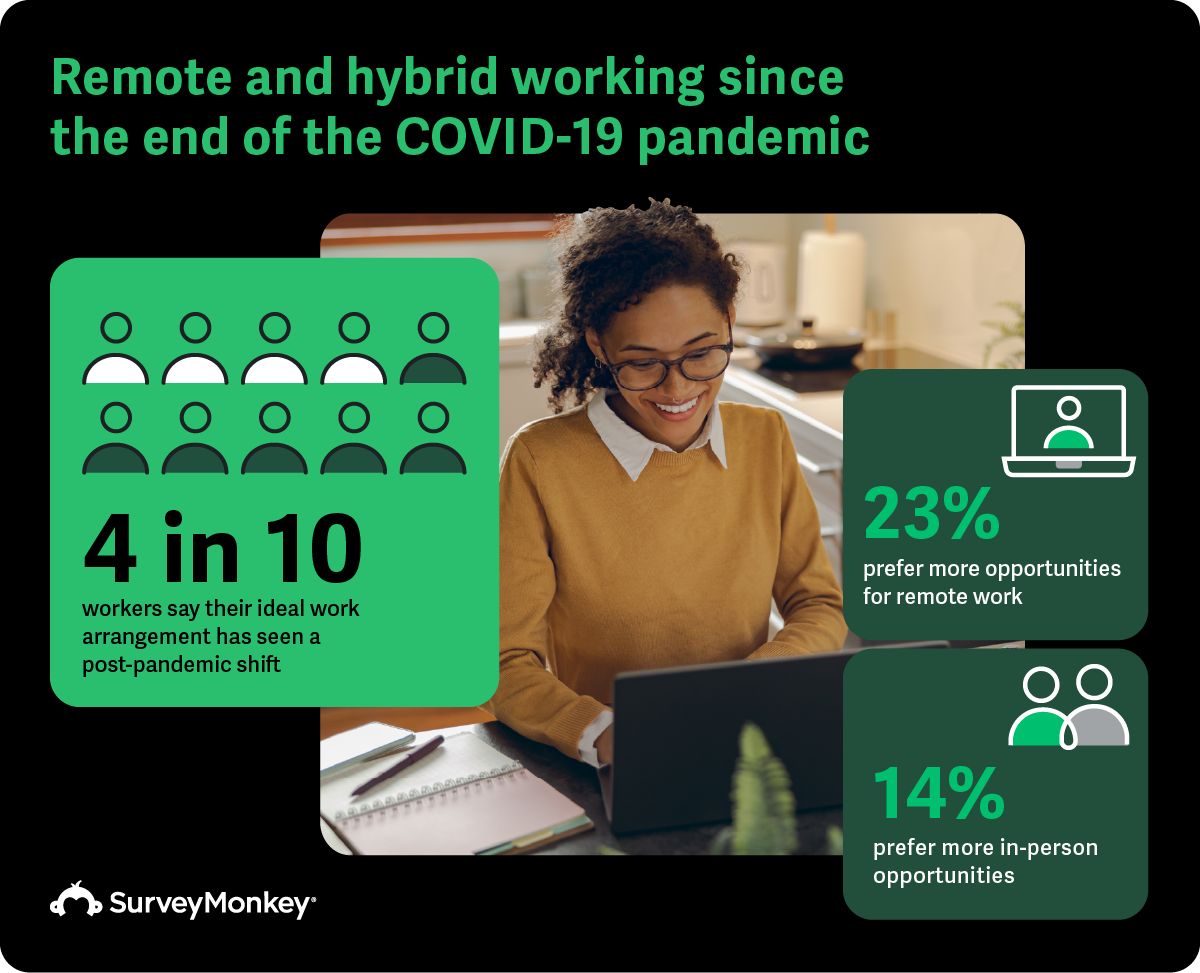
- Four in ten (38%) workers say their ideal work arrangement has seen a post-pandemic shift.
- 23% of American workers prefer more opportunities for remote work.
- 14% of American workers prefer more in-person opportunities.
- 37% would work remotely from another country if their employer allowed it.
- Half of remote (48%) workers believe company return-to-office mandates are about micromanaging employees.
- 29% of employees indicate they would look to leave their job if it became fully in-person.
- 37% of employees think that in-person work would help them connect better with management.
- 46% of workers are concerned about missing out on building relationships with coworkers.
- 33% worry that hybrid work creates difficulty in setting boundaries between home and work time.
How has the way we work changed in the six years since COVID-19?
Pre-2020, remote work was relatively rare, but that all changed when the COVID-19 pandemic hit. The world of work had to adapt rapidly, and working from home became essential during lockdowns. In the years since those restrictions ended, remote and hybrid work have become widely accepted models.
Remote work before the COVID-19 pandemic
According to Statista data, between 2017 and 2018, 34.7 million American full-time workers had the option to work from home. However, only 24% actually did. By 2020, this number increased by 48.7 million, totalling 57,028,000 employees (an increase of 585%).
Before the COVID-19 pandemic, Statista data shows that 47% of Americans had never worked from home before. In 2026, data from DemandSage indicates that there are 300 million daily active users of Zoom worldwide, a dramatic increase from 2019, when there were an estimated 10 million users.
Remote and hybrid work since the end of the COVID-19 pandemic
Data from our remote and hybrid work study reveals that nearly four in ten (38%) workers say their ideal work arrangement has seen a post-pandemic shift:
Among those who express a preference for remote work, the main factors are:
- Commute times (52%)
- Personal burnout or wellbeing (45%)
- Higher productivity levels (44%)
- Improved ability to focus (42%)
SurveyMonkey's remote and hybrid work research also shows that almost four in ten remote workers (37%) would work remotely from another country if their employer allowed it (36% for hybrid workers).
When it comes to working abroad, data from DemandSage reports that there are over 40 million digital nomads worldwide. 18.1 million are from the United States, an increase of 147% compared to the 2019 figures.
The world of work has clearly changed significantly since the pandemic, seeing an enormous increase in hybrid work opportunities, often for employees who’d never worked remotely before.
There’s also a mix of people who would either like more remote work opportunities or, conversely, to work more in-person with teammates. Businesses need to consider all preferences to find the right balance to keep employees happy.
Remote work and return-to-office statistics
SurveyMonkey's remote and hybrid work study reveals that 75% of Americans currently have a fully on-site work arrangement.
The data also shows that 15% are currently working completely remotely, with one in ten (10%) having a hybrid work arrangement between the home and the office.
Managing return-to-office arrangements
As of the start of the year, data from Resume Templates estimates that 27% of businesses in the US have now returned to a fully in-person model.
The top reasons for this include:
- Fostering collaboration (68%)
- Improved productivity (64%)
- Improving communication (61%)
For companies offering hybrid work, gathered data from Flex Index shows that the most popular mandated office days are:
- Monday (27%)
- Tuesday (78%)
- Wednesday (72%)
- Thursday (67%)
- Friday (8%)
Work from home vs. in office: How do employees really feel?
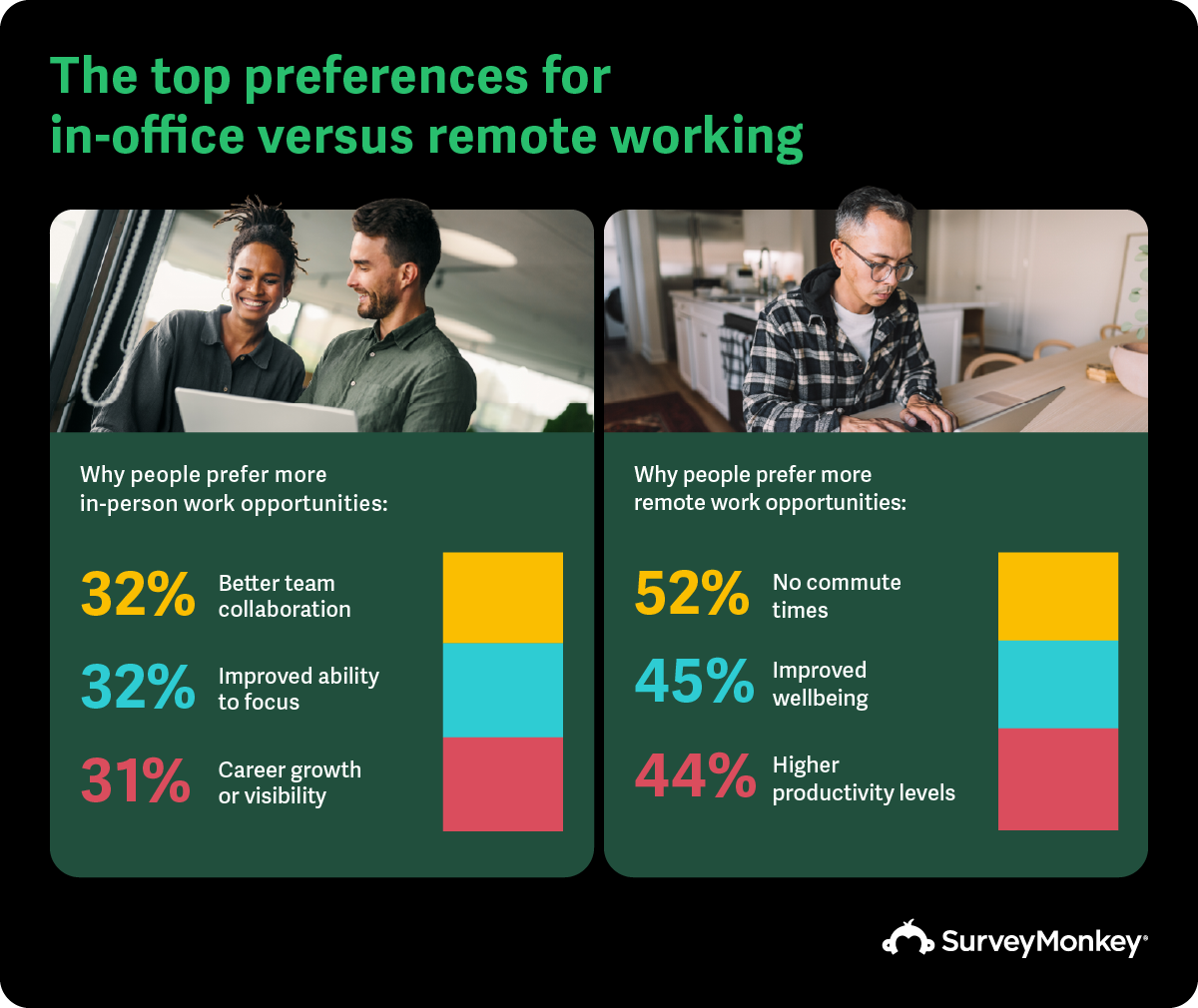
According to SurveyMonkey's remote and hybrid work research, Americans who prefer more in-person work do so for these reasons:
- Team collaboration needs (32%)
- Improved ability to focus (32%)
- Career growth or visibility (31%)
- Higher productivity levels (29%)
72% of remote workers (and 68% of hybrid workers) argue that remote work leads to a better work-life balance.
According to SurveyMonkey’s Work-life balance statistics for 2025, over a quarter (28%) of all employees rank work-life balance as the top motivator at work. In the same report, 36% of HR professionals cite burnout as the top reason for employee turnover.
SurveyMonkey's remote and hybrid work study reveals that remote workers are twice as likely as in-person workers to say that their management trusts them (61% vs. 31%).When it comes to trustworthiness, according to SurveyMonkey’s workplace trends that matter blog, 82% of all workers admit to spending some time on non-work activities during work hours:
- Household chores (46%)
- Running errands (33%)
- Taking a nap (20%)
Data from SurveyMonkey's remote and hybrid work research reveals 37% of employees think that in-person work would help them connect better with management, compared with working remotely.
However, half of remote (48%) workers believe company return-to-office mandates are about micromanaging employees, or companies wanting to maximize their office leases (46%), according to a 2024 SurveyMonkey Workplace Culture and Trends research report.
Additional data from SurveyMonkey's remote and hybrid work research revealed that if a remote or hybrid position became fully office-based, 29% of employees would look to leave their job.
The top industries that allow remote work
Data from a Flex Index remote working report reveals the sectors that are most open to this arrangement:
- Technology (94%)
- Insurance (92%)
- Professional services (82%)
- Media and entertainment (82%)
- Financial services (82%)
There’s a clear split in how employees feel about in-office vs. remote work. Remote work statistics show that the majority of Americans still work in-person, and those who prefer this environment do so for reasons including better collaboration, productivity, communication, focus, career growth, and visibility.
Meanwhile, remote workers claim that their model provides benefits such as better work-life balance and a greater feeling of trust. Many also feel that return-to-office mandates are about micromanaging and filling office space, with some willing to leave their job if companies enforced in-person work.
Looking to the future: Will hybrid work have long-term effects on workplace dynamics?
So, what is the future of hybrid work, and what will its long-term impact be on workplace and team dynamics?
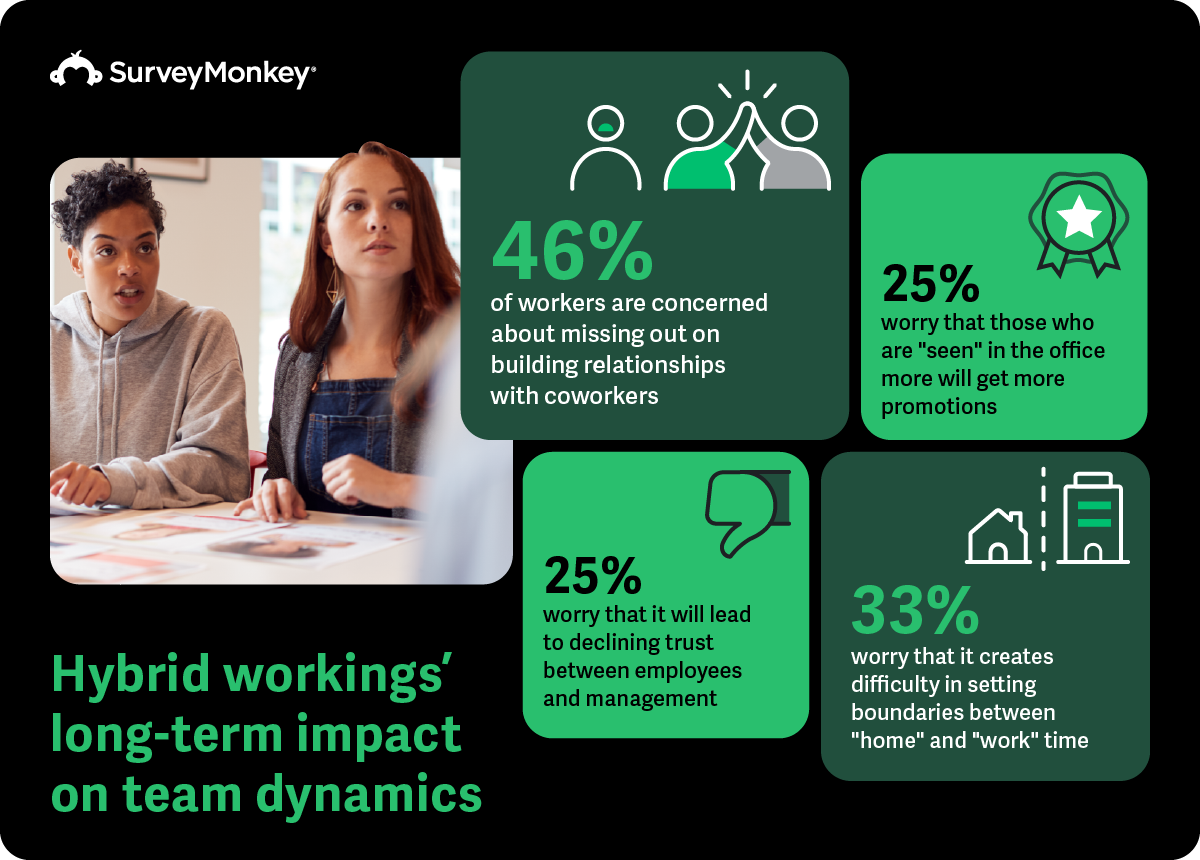
Hybrid work’s long-term impact on team dynamics
SurveyMonkey's remote hybrid work study reveals that nearly half (46%) of workers are concerned about missing out on building relationships with coworkers due to hybrid work.
A further 25% worry about career growth and feel that those who are more visible in the office will be more likely to get promotions.
Work-life balance comes up too, with 33% worrying that hybrid work creates difficulty in setting boundaries between home and work time.
An additional 25% of workers worry that junior staff will lose out on the unplanned learning that can occur when working closely with senior team members. With the same figure worrying that hybrid arrangements create challenges in onboarding.
And finally, 25% worry that it will lead to declining trust between employees and management.
The main concerns around the future of hybrid work are about relationships, visibility, work-home boundaries, learning opportunities, onboarding, and trust.
How to positively influence remote employee experience
Businesses wanting their workforce to feel valued and listened to need to consider the remote employee experience (REX), the comprehensive, daily perception workers have of their company, spanning everything from onboarding to offboarding.
SurveyMonkey’s guide, Remote employee experience (REX): basics and best practices guide, discusses several key areas that strongly influence REX, including:
Productivity: If remote and hybrid employees' needs are met, they’re more likely to be productive. And if they feel confident in their work environment, they’re more likely to remain motivated to do great work.
Work-life balance: This is a key factor for remote workers, and employers should consider the likelihood that these workers juggle other responsibilities - such as childcare - around their main work.
Employee health: Companies should also implement initiatives around stress and mental health to support employees’ well-being. If workers are struggling physically or mentally, their work performance will be below their potential.
Company culture: Bonding can be more challenging in a remote work environment, so businesses offering this arrangement should double down on company culture to better ensure a positive REX.
Training and development: Providing training and development opportunities to remote employees can be an impactful way to support skill growth and make workers feel valued.
Communication and collaboration: Communication and collaboration are more important than ever in remote arrangements. Managers must put extra effort into preventing employee silos.
Together, these key elements form the foundation for a strong REX.
The path ahead for remote work
The remote and hybrid work statistics we’ve explored show that the workplace landscape is still evolving. Pre COVID-19, working remotely was notably rare, but today millions of Americans work from home (or elsewhere) at least some of the time.
With a balance of employees whose preferences lean towards remote work or in-person arrangements, businesses need to actively listen to their workforce to create cultures that work for all.
The right balance should be struck between business interests and employee flexibility. Though this will be an ongoing dialogue, rather than a one-off policy decision.
By prioritizing regular check-ins and embracing a continuous feedback loop, management can stay aligned with their teams' needs and refine their approach in real-time to ensure the model works for everyone.If you’re a business considering how to tackle hybrid work arrangements, you might benefit from SurveyMonkey’s Return to Work Solutions or our Remote Work Check-In Survey pages.
Methodology
This SurveyMonkey remote and hybrid work study was conducted on February 3-6, 2026, among a sample of 3,581 US workers ages 18+. Respondents for this survey were selected from a non-probability online panel. The modeled error estimate for this survey is plus or minus 1.5 percentage points. Data have been weighted for age, race, sex, education, and geography using the Census Bureau’s American Community Survey to reflect the overall demographic composition of the United States.
Discover more resources

Attract, engage, and retain top talent with data-driven insights
Create powerful HR surveys with SurveyMonkey to gather feedback, boost engagement, and improve workplace culture. Streamline HR processes with customizable templates.

How SurveyMonkey uses SurveyMonkey to build a better global onboarding experience
See how SurveyMonkey uses SurveyMonkey to get real-time EX feedback, pivot strategies, and maintain 96%+ retention through the first 90 days.

USA TODAY | SurveyMonkey Workforce Survey 2026
USA Today|SurveyMonkey Workforce Survey 2026

The 3 workforce signals HR can’t afford to miss in 2026
We’ve distilled our SurveyMonkey Trends 2026 research into 3 HR priorities. Here’s what to do about shadow AI, employee burnout, and more.