Our findings on AI customer service versus human support from our CX-focused study reveal vital insights into what consumers really value.
Summary of the top AI customer service statistics:
- 79% of Americans strongly prefer interacting with a human over an AI agent.
- 63% of customers don’t believe AI could ever replace human beings in customer service roles.
- 56% of people have negative feelings about companies using AI as part of their customer experience.
- 84% of consumers believe human agents are more accurate than AI.
- 81% of people believe AI is used primarily to save money, not to improve service.
- 89% believe companies should always offer the option to speak with a human.
- 54% of consumers feel they can confidently identify when they’re interacting with an AI chatbot.
As businesses plan their 2026 strategies, these AI customer service statistics highlight the essential elements that matter most to consumers - and the findings may surprise those betting heavily on AI automation.
In this article, we will explore the key findings from relevant research and share expert advice on AI adoption in customer service.
Will consumers trust humans or AI more in 2026?
According to data from our consumers and AI in customer service study, consumers overwhelmingly prefer human over AI interaction when it comes to customer service.
The data also shows that more than half of people have negative feelings about companies using AI as part of the customer experience.
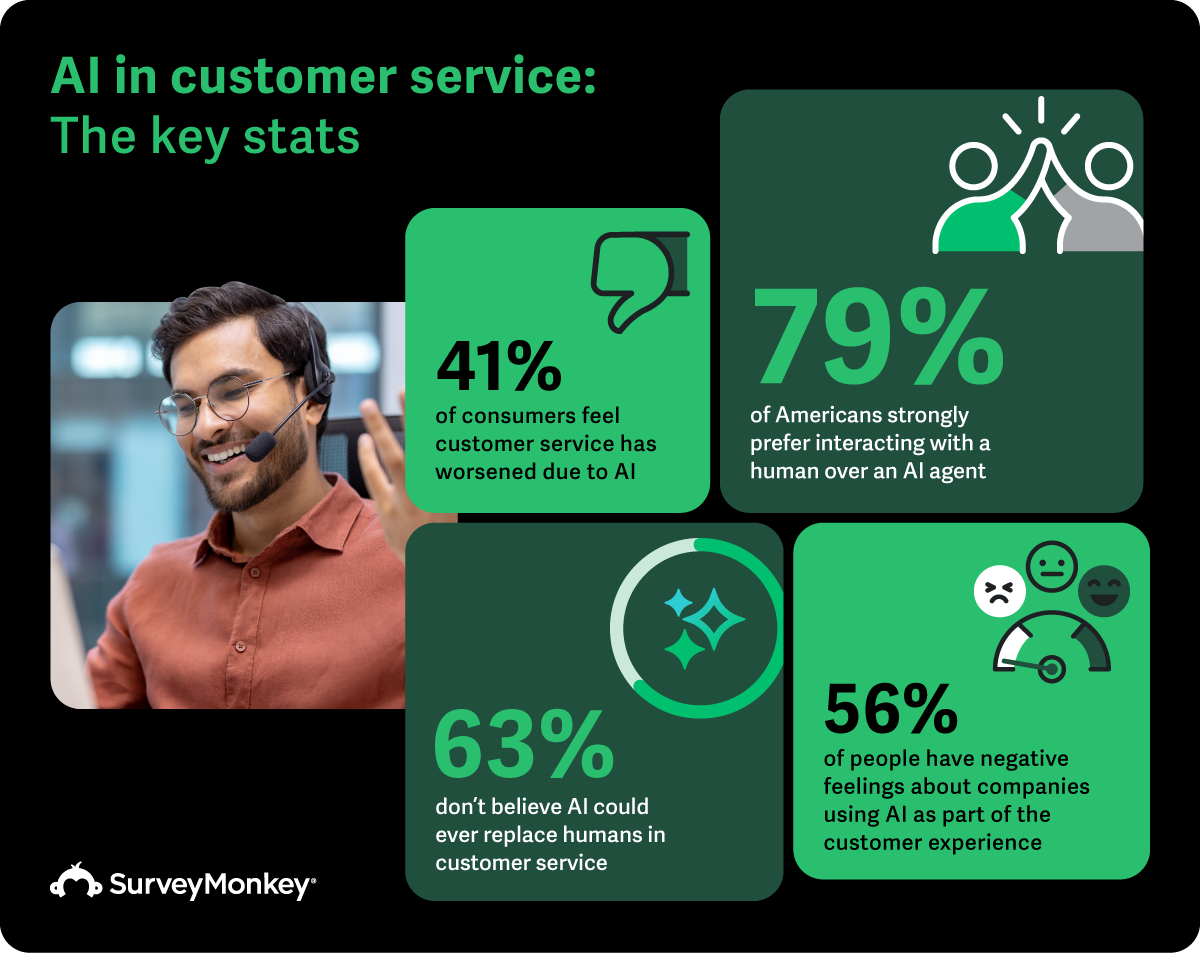
Another study by Kinsta supports this, revealing that 41% of consumers feel customer service has worsened due to AI, and 63% don’t believe AI could ever replace humans in customer service.
How many people prefer humans to AI in customer service?
Our 2025 CX-focused study on AI customer service statistics tells us that four in five (79%) Americans strongly prefer interacting with a human over an AI agent - a preference which is stronger in women than men (70% vs 60%).
When we break the data down by age, Gen Z and Millennials are more likely than older generations to prefer interacting with AI over a human agent, assuming equivalent speed and service quality. However, the numbers remain low (Gen Z 14%, Millennials 11%, vs Gen X 7%, Boomers 4%).
It’s clear from the findings that AI is seen as having a diminishing rather than enhancing effect on service quality, with widespread skepticism amongst Americans.
However, the fact that younger generations show a greater openness to AI may suggest that acceptance will increase over time.
Speed vs feeling understood: Why empathy still beats efficiency in customer service
So, why do consumers prefer human over AI interactions?
According to SurveyMonkey findings from our consumers and AI in customer service study, people feel that human agents better understand their needs (61%) and provide more thorough explanations (53%). They also believe humans are less likely to frustrate them (52%) and that humans give more options to address their issues (50%).
Additional insights from Kinsta also revealed that 84% of consumers believe human agents are more accurate than AI.

Our 2025 CX-focused study found that just 8% of respondents prefer AI over humans in customer service. The reasons given include better availability (41%), speed (37%), and more accurate information (30%).
Evidently, human customer service is the preference for the vast majority, as human agents are associated with high-quality service and positive outcomes.
Meanwhile, a small but notable minority prefer AI-based customer service, for reasons of availability, speed, and accuracy.
Consumer preference for using AI in different sectors in 2026
AI customer service is already used in numerous sectors, but how happy are consumers to trust their interactions to this technology?
The answer depends on the industry and the interaction in question, meaning that some sectors may have more opportunities for AI adoption than others.
Additional data from SurveyMonkey’s 2025 CX-focused study shows that consumers would overwhelmingly prefer human assistance in several situations:

Other SurveyMonkey research on consumers and AI in customer service reveals that over two-thirds of consumers would be uncomfortable using AI for medical advice (69%) or investment advice (68%).
Areas where people would be happy to use AI include ordering food and drinks (65%), returning an item (59%), and completing work or school tasks.
These findings suggest that while people trust AI for routine queries and general information, they trust human agents much more for sensitive, complex, or nuanced issues.
AI customer service adoption: Why consumers want human oversight
Consumers are doubtful about the value of AI customer service agents.
According to AI customer service cost savings statistics, including the 2025 study from Kinsta, 81% of consumers believe AI is used primarily to save money, not to improve service.
Eighty-nine percent also believe companies should always offer the option to speak with a human. A 2025 Twilio report reveals that 78% of consumers say it’s important to be able to switch from an AI agent to a human agent
The Kinsta report also reveals that 50% of consumers would cancel a service if they found it was solely AI-driven, and 42% would even be willing to pay extra for access to human representatives.
In direct contrast, the Twilio report shows that 83% of business leaders believe conversational AI can replace human agents.
What is evident is that consumers are skeptical about the motivations behind a business using AI, believing it’s a money-saving, rather than a service-improving tactic.
Meanwhile, business leaders are more optimistic about AI’s usage, highlighting a clear gap between corporate expectations and consumer preferences.
Getting the balance right between humans and AI for the best customer experiences
When considering human vs AI customer service, it’s important to understand the significant impact a good or bad experience can have for a brand.
According to data from SurveyMonkey’s 2025 CX-focused study, consumers want both product and customer service quality, with 73% saying they’re equally important.
Our research also suggests that positive interactions have a bigger impact than negative ones.
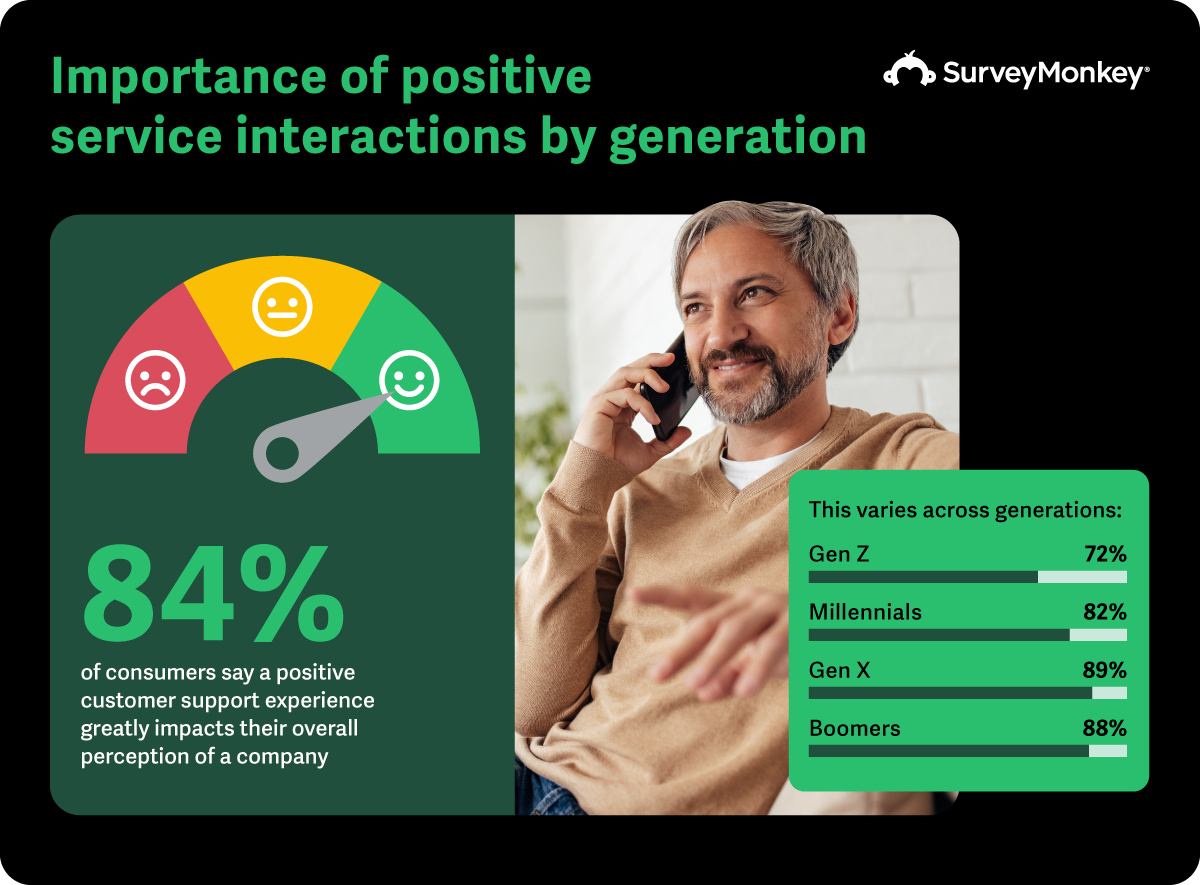
84% of consumers say a positive customer support experience greatly impacts their overall perception of a company, while 73% feel similarly about negative experiences.
There are some generational differences, however, with Gen Z being less impressed with positive interactions than older generations (72% vs Millennials 82%, Generation X 89%, and Boomers+ 88%).
Gen Z also seems to be less fazed by negative customer support experiences (59% vs Millennials 68%, Generation X 79%, and Boomers+ 81%).
How many people can spot an AI bot?
Exploring how consumers feel about transparency in generative AI customer service, our Q4 2025 AI-sentiment study found 14% of consumers would lose trust in a business if they interacted with an AI agent that doesn’t clearly explain it is AI.
SurveyMonkey research on consumers and AI in customer service also revealed that 54% of consumers feel they can confidently identify when they’re interacting with an AI chatbot. 47% also believe they can identify AI-generated content.
Younger consumers are much more confident in their ability to do this. 66% of 18-34-year-olds think they can identify AI chatbots, and 59% believe they can identify AI-generated content.
Confidence drops in older generations. Among 35-64-year-olds, 55% feel they can spot chatbots, and 49% AI-generated content. For those over 65, these numbers drop to 34% and 28%, respectively.
What is clear is that both human agents and AI bots have their advantages for interacting with a business's customer queries. The difficult part is getting them to work efficiently together.
This is made clear in research from Twilio, which stated only 15% of consumers experience a seamless handoff from AI to human agents, which can reduce the overall customer experience.
What’s next in AI customer service? Two key things companies need to consider for 2026
Sabrina Leblanc, senior vice president for sales and customer success at SurveyMonkey, has shared some expert guidance for businesses.
There are two points Sabrina believes businesses considering AI adoption for customer service must address:
1. Avoid jumping to full automation
“AI will deliver the speed customers expect, but human connection will ultimately determine who earns their loyalty. While AI can inform and personalize interactions more deeply than ever, it cannot replace the trust-building moments that only come from personal connection.
Companies that automate too aggressively, too early, risk losing the opportunity to tie into the thread of the customer’s emotional experience. To keep interactions empathetic, cohesive, and trustworthy, progressive organizations will pair powerful automation with intentional human oversight.”
2. Find the right balance between human and AI
“Finding the right balance requires a shift in how we listen. Lifecycle listening will become the backbone of CX - and feedback without action will be a competitive liability. We must use AI to speed up analysis, but human interpretation of nuance and emotion remains essential to closing the loop.
To win, teams must keep humans in the loop - using AI to accelerate the work, not replace the relationship - to deliver the authenticity and emotional intelligence customers remember and come back to.”
Balancing AI and human support: Key takeaways from 2026 customer service statistics
While AI adoption is accelerating in customer service, these AI customer service stats show that this isn’t necessarily what consumers want.
Human agents remain essential for their ability to understand and solve complex problems empathetically.
And while AI offers benefits like speed and availability, companies need to find the right balance to succeed in 2026 and beyond.
The findings are clear - AI can support and even enhance human interaction, but it shouldn’t replace it altogether.
Methodology
The 2025 CX-focused SurveyMonkey study was conducted on December 10-11, 2025 among a sample of 2,017 US adults ages 18+. Respondents for this survey were selected from a non-probability online panel. The modeled error estimate for this survey is plus or minus 2.5 percentage points. Data have been weighted for age, race, sex, education, and geography using the Census Bureau’s American Community Survey to reflect the overall demographic composition of the United States.