
At a glance
- Marketers spend more than $500 billion on ads worldwide, making pre-launch testing critical to protecting that spend.
- Test several stimuli per round with a monadic or sequential monadic design and score results with Top 2 Box scoring.
- Track metrics like appeal, believability, and purchase intent consistently so ad comparisons stay fair.
- SurveyMonkey LaunchPad helps you design, field, and analyze ad tests.
How confident are you in your advertisement? Whether you want your ad to increase sales or raise brand awareness, you need one you know will work. There's no better way to be confident about an ad than to see that it's tested well.
Ad testing is the process of putting different ads in front of a sample of your target audience and asking for feedback. You can run ad tests on an entire ad or on specific aspects of it, and collect feedback on anything from how much the ad stands out to how believable your audience finds it.
Try Ad Testing from SurveyMonkey LaunchPad
Test ad creative with your target audience and get automated scorecards without building the analysis by hand.
Why ad testing matters
The amount brands spend on ads is astronomically high: more than $500 billion is spent on ads worldwide, and that figure keeps growing.
Brands spend this aggressively because ads work. Consumer packaged goods (CPG) brands, for example, see a solid return on ads across media types. Pre-launch testing to home in on the right ad concept only grows the odds of a strong return.
Measuring advertising effectiveness through testing offers four additional benefits.
- It gives you data to back up your decisions. Nobody can argue against hard numbers. If you can prove which ad concepts are the best, you should have an easy time persuading colleagues to run with the winning ads.
- It provides ideas for further improvement. Your winning ad might not be perfect. For example, say you’re focused on copy testing. Your audience likes the winner, but they don’t find its message completely believable. This input gives you a chance to take already likeable copy and make it even better!
- It allows you to understand and segment different audiences. Once your responses come back, you can filter them to see how different groups (e.g. male vs. female) feel about each of your ads. These insights can help you pick specific ads for individual groups, or make a single ad that tries to incorporate elements each group likes.
- It helps your organization iterate quickly. The ability to do so is associated with performing agile market research: a method of research that involves frequent rounds of data collection to account for an organization’s needs over time. Agile research empowers your team to make better decisions more often, and rely less on insights organizations, agencies, or other types of businesses.
Need a dedicated market research partner?
Our experts can help design, field, and analyze studies.
How to run an ad test
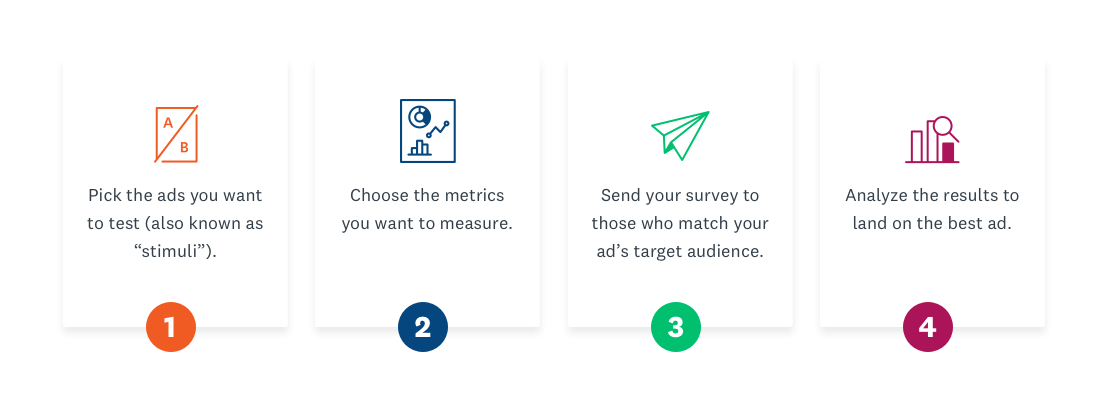
Now that you know why assessing advertising effectiveness is so important, you’re ready to dive into the process of testing your ads. Here are the 4 key steps you’ll need to follow:
1. Determine the stimuli to test
Your stimuli can take the form of videos, images, copy, audio, or a combination. As you decide on format, also consider content based on where each ad will run; you might tailor a LinkedIn ad to professional networkers differently than a Facebook ad or a Google search ad.
Use at least three stimuli per test for a fair read on your target audience's preferences. The exact number also depends on your survey design: monadic or sequential monadic.
| Survey design | How it works | Trade-off |
| Monadic | Each respondent sees and rates only one stimulus; results are compared across separate respondent groups afterward | Lets you ask more questions per stimulus and keeps each survey short, but needs a larger total audience, which can get costly |
| Sequential monadic | Each respondent sees two or more stimuli and answers the same questions on each | Needs a smaller total audience, which is more cost-effective, but limits how many questions you can ask per stimulus to keep the survey a manageable length |
If you'd rather use a monadic design, stick to testing only a few stimuli. If you want a sequential monadic design, you can comfortably test more. Learn more about the pros and cons of each design and how to set them up.
2. Pick the metrics you want to measure
What makes one ad better than another? The metrics you measure help you decide. Consider these top ad metrics:
- Appeal: is your ad’s imagery and message enticing?
- Believability: does your ad’s message seem credible?
- Purchase intent: will your ad motivate people to buy what it’s selling?
- Relevance: does the ad cater to your audience’s needs and wants?
- Uniqueness: is your ad different from others?
Which metric matters most depends on your goal. If your top priority is influencing sales, purchase intent may matter most. If brand differentiation is the focus, uniqueness may take priority instead.
Measure any metric with a Likert scale question following the format "How (metric) is the ad?" with answer choices ranging from "Extremely (metric)" to "Not at all (metric)." For believability, that looks like:
How believable is the ad?
- Extremely believable
- Very believable
- Somewhat believable
- Not so believable
- Not at all believable
Your ad testing survey should also ask screener, category, and demographic questions. Learn more about each in the comprehensive concept testing resource.
Want help from market research pros? Looking for ways to refine your skills?
These resources can be just what you’re looking for!
Ultimate guide to running market research: This resource has everything you need to run market research, from planning your study to taking action!
Ad testing survey template: This expert-certified survey template can help you brainstorm your questions. You can also use it and edit it however you’d like.
SurveyMonkey Audience: Our global consumer panel allows you to survey people in more than 130 countries.
Market Research Services: From survey consultation to team trainings, our experts will ensure that your research on SurveyMonkey Audience runs smoothly.
3. Send your survey to your target audience
You can only judge the quality of your ads once your target audience evaluates them. Find your target profile and give them a chance to provide feedback in one of two ways.
- A focus group works well for collecting in-depth feedback across a variety of questions, but focus groups can be costly to organize, and you likely won't gather feedback from a representative sample of everyone who'll eventually see your ads.
- SurveyMonkey Audience, a market research panel, lets you specify exactly who you want to reach and how many people to survey, then collect feedback within minutes. This option is more cost-effective than a focus group, reaching more people at a lower cost, though the feedback may be less in-depth.
4. Analyze your results with a score card and word clouds
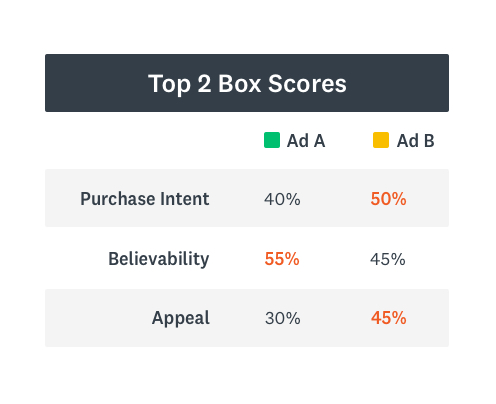
Once responses come in, compare the ads against each other. To focus on the data that matters most and keep analysis straightforward, use Top 2 Box scores: combine the two most positive answer choices for each metric into a single percentage. If 30% of respondents said an ad was extremely believable and 20% said very believable, your Top 2 Box score is 50%.
Compare an ad's Top 2 Box scores across every metric against the other ads you tested. In one illustrative example, Ad B wins on purchase intent and appeal while Ad A wins on believability; assuming each metric matters equally, Ad B would be the pick over Ad A. This is the kind of side-by-side scorecard result this method is designed to produce once your own responses come in.
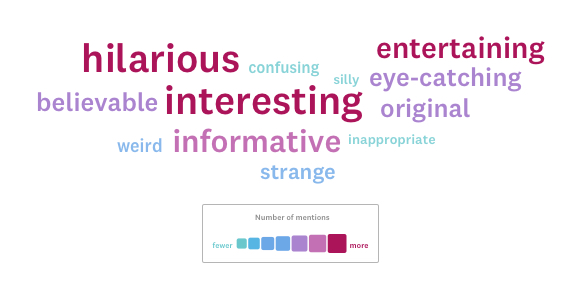
Don't skip your open-ended questions, the ones without preset answer choices. A word cloud can help you quickly spot the key takeaways on each ad.
For a deeper walkthrough of every step, read the ultimate guide to concept testing.
You can also try in-market testing, which pushes concepts live and measures performance through A/B testing, showing a percentage of your real audience each ad.
In-market testing tells you how people actually respond, but it's riskier and costlier since some concepts may perform poorly live.
The strongest approach uses both: test ads before they go live, then A/B test the shortlist of winners to see how each performs in the real world.
How ad tests evolve during different phases of the product life cycle
While your product is in development, you'll have other testing priorities, like name or logo testing.
Begin ad testing once your product launches. At this point, since everything about your ads is brand new to your audience, look for broad, directional feedback, and home in on the messages that resonate most before moving forward.
As your product matures, your testing should get increasingly specific. In the maturity phase, you might test different image concepts for the ad. By the saturation phase, you might be dialed in enough to test only the colors of the image you already plan to use.

Running several ad tests across the product life cycle is rooted in agile market research, a methodology built on frequent rounds of data collection that account for an organization's needs over time. It's a manageable process that empowers your team to make better decisions more often.
Best practices for ad testing
Stay on top of these five things as you begin testing.
- Keep the metrics consistent across your ads. Ask the same set of questions on each ad so comparisons stay fair.
- Use high-quality visuals. Fuzzy video or images make it harder for respondents to give feedback and can worsen the perception of your brand.
- Survey a statistically significant number of people. If reaching enough people who fit your target audience is difficult, use a research panel.
- Track the number of questions you ask. Limit any ad testing survey to 30 questions. More than that increases the chances respondents race through with little thought or drop out entirely.
- Benchmark your results. Determine an ad's effectiveness more precisely by comparing it to competitors' ads or ones you've used previously. Include rivals' ads and your older ads in the survey to see how they measure up.
Frequently asked questions about ad testing
- What is ad testing?
- What are ad tests used for?
- What's the difference between testing advertising before launch and A/B testing?
- What does ad testing research typically measure?
Start performing ad testing with SurveyMonkey LaunchPad
You've learned why ad testing matters, how to run your own test, and how to keep your results reliable.
SurveyMonkey offers a range of market research solutions, from do-it-yourself surveys to fully managed studies.
Ad Testing from SurveyMonkey LaunchPad handles the survey design and analysis for you, so you can rest easy knowing the days of launching high-risk ads are over.
If you'd rather hand the legwork to someone else, SurveyMonkey Market Research Services can design, field, and analyze a custom study for you, from questionnaire design through the final report.
Start performing ad testing with SurveyMonkey expert solutions today
Discover more resources

Solutions for your role
SurveyMonkey can help you do your job better. Discover how to make a bigger impact with winning strategies, products, experiences, and more.

AI agents vs chatbots: what changes when a survey project is on the line
See how AI agents differ from chatbots at each stage of a survey project, from writing the brief to analyzing the results.

How to run a customer needs analysis
Learn how to run a customer needs analysis that turns interviews and survey data into a ranked list of opportunities your team can act on.

How to do market research for a business plan
Learn how to gather market definition, segment, competitor, and demand evidence for the market analysis section of your business plan.