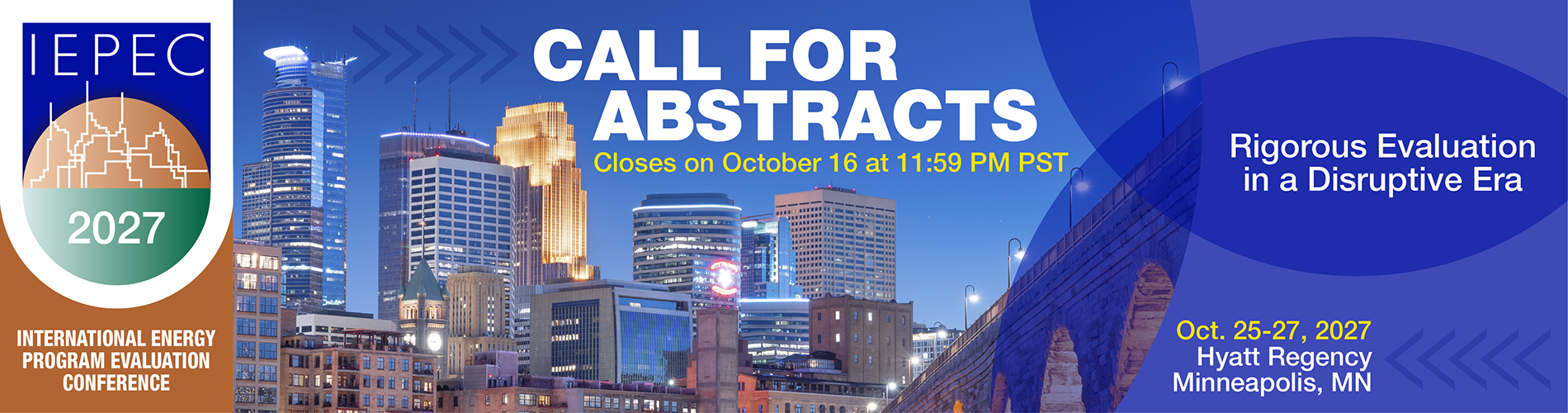
1.The International Energy Program Evaluation Conference 2027 Abstract Submission Form
Overview:
IEPEC is excited to announce the Call for Abstracts for the 2027 conference, being held on October 25th-27th, in Minneapolis, MN. This year's theme is Rigorous Evaluation in a Disruptive Era.
The theme signals our commitment to methodological rigor and providing meaningful evaluation insights in a time of new tools, focus areas, funding shifts, and the evolving shape of energy programs. We hope to cover key topics related to this theme, such as:
IEPEC is excited to announce the Call for Abstracts for the 2027 conference, being held on October 25th-27th, in Minneapolis, MN. This year's theme is Rigorous Evaluation in a Disruptive Era.
The theme signals our commitment to methodological rigor and providing meaningful evaluation insights in a time of new tools, focus areas, funding shifts, and the evolving shape of energy programs. We hope to cover key topics related to this theme, such as:
- Evaluation at the Speed of Disruption
- Maintaining Rigor Under Pressure
- New Tools, New Questions
- Equity in a Shifting Landscape
Please keep these topics in mind as you submit your abstract. (click here to read more about the conference theme)
Abstract Submission Details and Instructions:
Abstract Submission Details and Instructions:
Please use this form to submit proposed papers, panels, and posters. A different form will be shared for workshop proposals.
Abstracts will be accepted until Friday, October 16, 2026, 11:59 PM Pacific Time.
Abstracts will be accepted until Friday, October 16, 2026, 11:59 PM Pacific Time.
Authors may submit multiple abstracts. However, each abstract must be submitted separately and address different content. A maximum of two papers and one panel per primary author will be accepted. An author with two accepted papers may be contacted by IEPEC to identify an alternate presenter for one of the accepted papers.
Note that the number of papers accepted from each company may be limited to ensure broad participation. If a company has too many qualifying abstracts, IEPEC may contact a company representative to discuss which papers to include in the conference.
Abstract types:
Note that the number of papers accepted from each company may be limited to ensure broad participation. If a company has too many qualifying abstracts, IEPEC may contact a company representative to discuss which papers to include in the conference.
Abstract types:
- Paper: Requires you to write a full paper. You may choose between a paper with a full presentation (12-20 minutes) or lightening presentation (5-7 minutes).
- Poster: Requires a one-page summary and tabletop display.
- Panel: No paper required. You will need a moderator and 3-4 panelists.
Additional requirements:
- Abstract submittals (papers, posters, and panels) must be original work that has not been presented or published elsewhere.
- Exclude from the abstract text identifying information (e.g., evaluator and client name or affiliation, unique program names).
- When submitting the abstract, you will be asked to select one category from each of the following groups: Evaluation Area, Sector and Focus.
- For Panels: Address the following in your description.
- What issue will the panel address?
- Who will the panelists be?
- How will this discussion be useful to the audience?
- How will you ensure discussion, deliberation, and/or debate beyond mere presentation of information?
Before you begin, you should have the following information at hand:
- Type of abstract (paper, poster, or panel)
- A 500-word (MAXIMUM) plain text abstract. Do not include identifying information (such as client or program names) as paper abstract submissions are subject to blind peer review.
- Name and contact information of up to three authors/panelists (if applicable).
- Type of research
- Scope of coverage
- Sector
If you have questions, please email Kisha Gresham at kishagresham@iepeconference.onmicrosoft.com.
NOTE: IEPEC papers are intended for the sharing of research, evaluation findings, and program insights among energy efficiency professionals. Papers may not be used to market, advertise, or promote commercial products, services, or vendors.