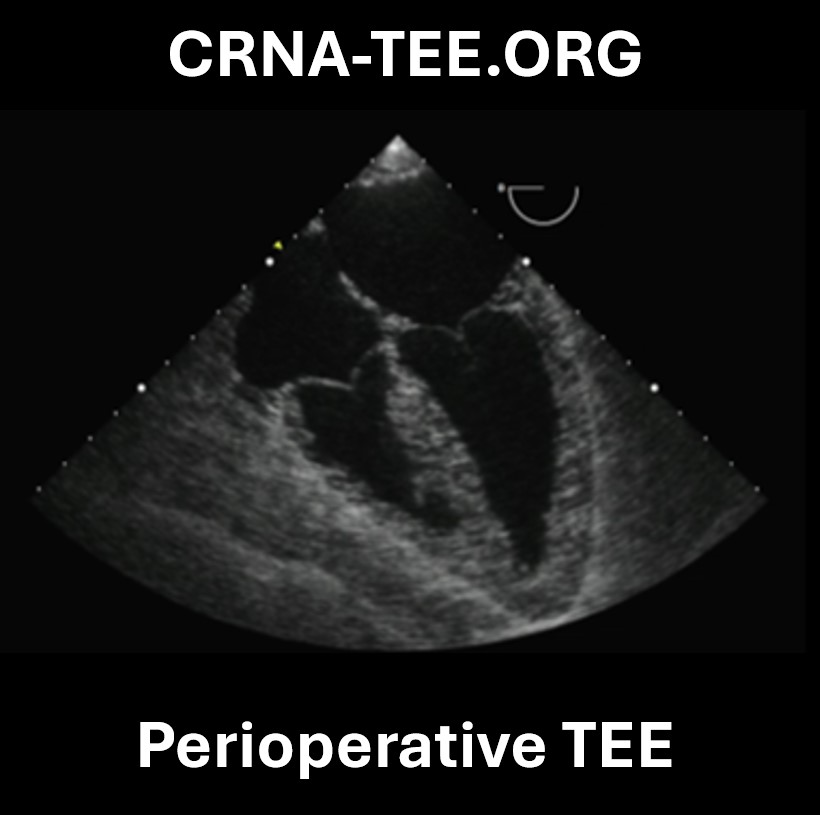
Rescue TEE Question Title * 1. The lower the frequency of an ultrasound wave the greater the ________________________. resolution velocity amplitude depth of penetration Question Title * 2. A good general rule in regards to determining flow using Doppler and color flow mapping is Blue color means blood is flowing towards the transducer Red color means blood is flowing towards the transducer Brighter colors means the flow velocity is slow Orange color means the blood flow is perpendicular to the tranducer Question Title * 3. Absolute contraindications to transesophageal echocardiography exam include Perforated esophageal viscous and bleeding Atlantoaxial joint disease Prior radiation to the chest History of dysphagia Question Title * 4. Sites of potential injury during transesophageal echocardiography exam with experienced sonographers/clinicians include Oral (e.g., dental and lip trauma) Oropharyngeal trauma (e.g., laceration, perforation) Gastric trauma (e.g., laceration, perforation) All of the above Question Title * 5. Which of the following is an important consideration for transesophageal echocardiography probe insertion and safety? Verify functioning anteflex/retroflex and lateral tilt knobs prior to insertion Ensure the transducer head is facing downwards during insertion Advance until the stomach is seen before starting/acquiring first view Never freeze the transesophageal echo image Question Title * 6. The large knob on the TEE probe controls __________ while the small knob controls ___________. Anteflexion/retroflexion; image rotation Left/right tilt; image rotation Anteflexion/retroflexion; Left/right tilt Image rotation: anteflexion/retroflexion Question Title * 7. What is this rescue TEE view and what is your interpretation? midesophageal long axis view, normal left ventricular function transgastric short axis view, hypovolemia transgastric short axis view, severely depressed left ventricular function midesophageal aortic valve short axis view, euvolemia Question Title * 8. What is this rescue TEE view and what is your interpretation? midesophageal long axis view, normal left ventricular function transgastric short axis view, hypovolemia transgastric short axis view, severely depressed left ventricular function midesophageal aortic short axis view, euvolemia Question Title * 9. A 20-year-old woman experienced a cardiac arrest with pulseless electrical activity in the computed tomography scanner after a motor vehicle accident and level I trauma activation. What is this rescue TEE view and what is your interpretation? midesophageal four chamber view, severely depressed left ventricular function midesophageal long axis view, pleural effusion midesophageal four chamber view, pericardial effusion midesophageal four chamber view, hypovolemia Other (please specify) Question Title * 10. What is this rescue TEE view and what is your interpretation? transgastric short axis view, severely depressed left ventricular function transgastric short axis view, normal left ventricular function transgastric short axis view, anterior wall motion abnormality probably myocardial ischemia transgastric short axis view, inferior wall motion abnormality probably myocardial ischemia Question Title * 11. What is this rescue TEE view and your interpretation? midesophageal four chamber view, severe mitral regurgitation midesophageal four chamber view, severe mitral stenosis midesophageal four chamber view, mild-moderate central mitral regurgitation related to LV dysfunction midesophageal long axis view, mild mitral stenosis Question Title * 12. A 53-yr-old male presents to the operating room for urgent exploratory laparotomy. After induction with propofol, cisatracurium, and fentanyl, his blood pressure is 60/40 mmHg, and his heart rhythm demonstrates sinus tachycardia with a rate of 130 beats-min–1. Despite several boluses of phenylephrine and epinephrine and intravenous fluid resuscitation, there is no change in his hemodynamic status. What is this rescue TEE view and your interpretation? midesophageal four chamber view, anterior wall motion abnormality midesophageal long axis view, HOCM with septal anterior motion (SAM) midesophageal four chamber view, mitral stenosis midesophageal long axis view, aortic stenosis Other (please specify) Question Title * 13. 86-year-old woman presents with with persistent atrial fibrillation and recurrent admissions for gastrointestinal bleeding after placement of a left atrial appendage closure (LAAC) device. She is extremely short of breath and receiving oxygen. What is this rescue TEE view and your interpretation? midesophageal bicaval view with atrial septal defect midesophageal aortic valve short axis view with right ventricular dysfunction midesophageal aortic valve short axis view with bicuspid aortic valve midesophageal aortic valve long axis view with right ventricular dysfunction Other (please specify) Question Title * 14. 67-year-old man with no prior cardiac disease fell from a height of 10 to 12 m and was initially treated for multiple traumatic injuries at a local hospital. What is this rescue TEE view and your interpretation? midesophageal bicaval view with atrial septal defect midesophgeal aortic valve short axis view with right ventricular dysfunction midesophageal long axis view with severe aortic regurgitation midesophageal long axis view with severe mitral regurgitation Other (please specify) Question Title * 15. 28-year-old women with a history of hypertension was admitted to the obstetrics hospital. Two attempts at labor induction were unsuccessful. A decision was made to proceed with a cesarean section. Due to the patient’s deteriorating condition, TEE was indicated. What is this rescue TEE view and your interpretation? midesophageal descending aorta short axis view with dissection midesophageal bicaval view with pericardia effusion transgastric short axis view with left ventricular dysfunction midesophageal bicaval view with atrial septal defect Other (please specify) Question Title * 16. 28-year-old female with a history of morbid obesity (BMI50), type 2 diabetes presentedafter being struck by an automobile traveling approximately25 mph and an initial loss of consciousness. Other injuries includedfractures of the left clavicle, left fibular neck, and left ankle. Subsequently the patient had sudden onset hypoxia and hypotension. What is this rescue TEE view and your interpretation? midesophageal aortic valve short axis view with severe aortic stenosis midesophageal four chamber view with pulmonary embolus and severe tricuspid regurgitation midesophageal bicaval view with atrial septal defect with left to right flow midesophageal four chamber view with severe mitral regurgitation Other (please specify) Question Title * 17. What is this rescue TEE view and your interpretation? midesophageal four chamber view, mitral regurgitation Midesophageal ascending aorta long axis view, mitral regurgitation Midesophageal ascending aorta short axis view, aortic dissection Midesophageal bicaval view, atrial septal defect Question Title * 18. 31-year-old male from Ecuador who underwent a valvuloplasty at age 13. You suspect a more complex presentation based on his symptoms despite being "cleared" by transthoracic echo. What is this rescue TEE view and your interpretation? midesophageal aortic valve short axis view, severe aortic stenosis midesophageal descending aortic short axis view, aortic dissection midesophageal long axis view, hypertrophic cardiomyopathy midesophageal aortic valve short axis view, aortic dissection Other (please specify) Question Title * 19. 85-year-old man presents complaining of recurrent fever and a murmur. He has a past history significant for atrial fibrillation being treated with apixaban status post leadless pacemaker implantation and AV nodal ablation 15 days ago, hypertension, hyperlipidemia, obstructive sleep apnea on continuous positive airway pressure. He subsequently became unstable requiring intubation and pressor support for low oxygen saturation and hypotension. What is this rescue TEE view and your interpretation? midesophageal long axis view, aortic regurgitation midesophageal four chamber view, mitral regurgitation midesophageal aortic valve short axis view, aortic regurgitation midesophageal bicaval view, atrial septal defect Other (please specify) Question Title * 20. A 58-year-old woman with chronic renal failure, atrial fibrillation (AF), and mitral valve disease is undergoing urgent bowel resection. Intraoperative transesophageal echocardiography (TEE) is requested to determine the significance of her heart valve disease and to guide hemodynamic management. What is this rescue TEE view and your interpretation? midesophageal four chamber view, mitral stenosis with left atrial enlargement midesophageal four chamber view, mitral regurgitation with left atrial enlargement midesophageal long axis view, aortic stenosis with aortic enlargement midesophageal long axis view, hypertrophic cardiomyopathy (HOCM) with SAM Other (please specify) Done