#Enzian 2025

Dear Colleagues,

Thank you for your continued commitment and expertise in advancing the #Enzian Classification. As part of the ongoing effort to refine and expand the system, we invite you to participate in this brief survey focused on compartment-specific proposals.

The survey will take approximately 5 minutes to complete. We greatly appreciate your valuable time and contribution to this important work.


Section 1: Refining the #Enzian “B” Compartment


Background

The current #Enzian classification defines “B” compartment lesions (uterosacral ligaments and parametrium) using B1–B3 categories based on size and depth of invasion.
However, this system does not distinguish between medial lesions (uterosacral) and lateral lesions involving the pelvic sidewall, which can significantly impact surgical complexity, particularly due to the proximity to the ureter and sacral nerve roots.
This part of the survey seeks your feedback on a proposed modification: adding a “p” suffix to denote pelvic sidewall involvement (e.g., B3p).
1.In your practice, how often do B3 lesions with lateral extension (e.g., ureteric or nerve involvement) affect your surgical planning?(Required.)
2.In the context of refining the #Enzian classification, do you agree that the current B1–B3 #Enzian staging is insufficient in distinguishing lateral/pelvic sidewall involvement?(Required.)
3.If your answer is “YES” in question number 2, do you support adding a “p” suffix (e.g., B2p) to indicate pelvic sidewall or lateral parametrium involvement?(Required.)
4.If your answer is “Yes” in question number 3, would you favour additional sub-classification within the “p” group to indicate the level or structures involved? (e.g., pu = Ureter medialization, pn= Nerve involvement)(Required.)
5.Do you have any additional suggestions for modifying or improving the “B” compartment current #Enzian system?(Required.)
6.In your expert opinion, should the current “B” compartment be split into distinct medial (uterosacral) and lateral (pelvic sidewall/parametrium) categories within the classification, rather than relying on suffixes? If so, how would you define the anatomical boundaries between them in a reproducible way?(Required.)


Section 2: Refining the #Enzian “T” Compartment
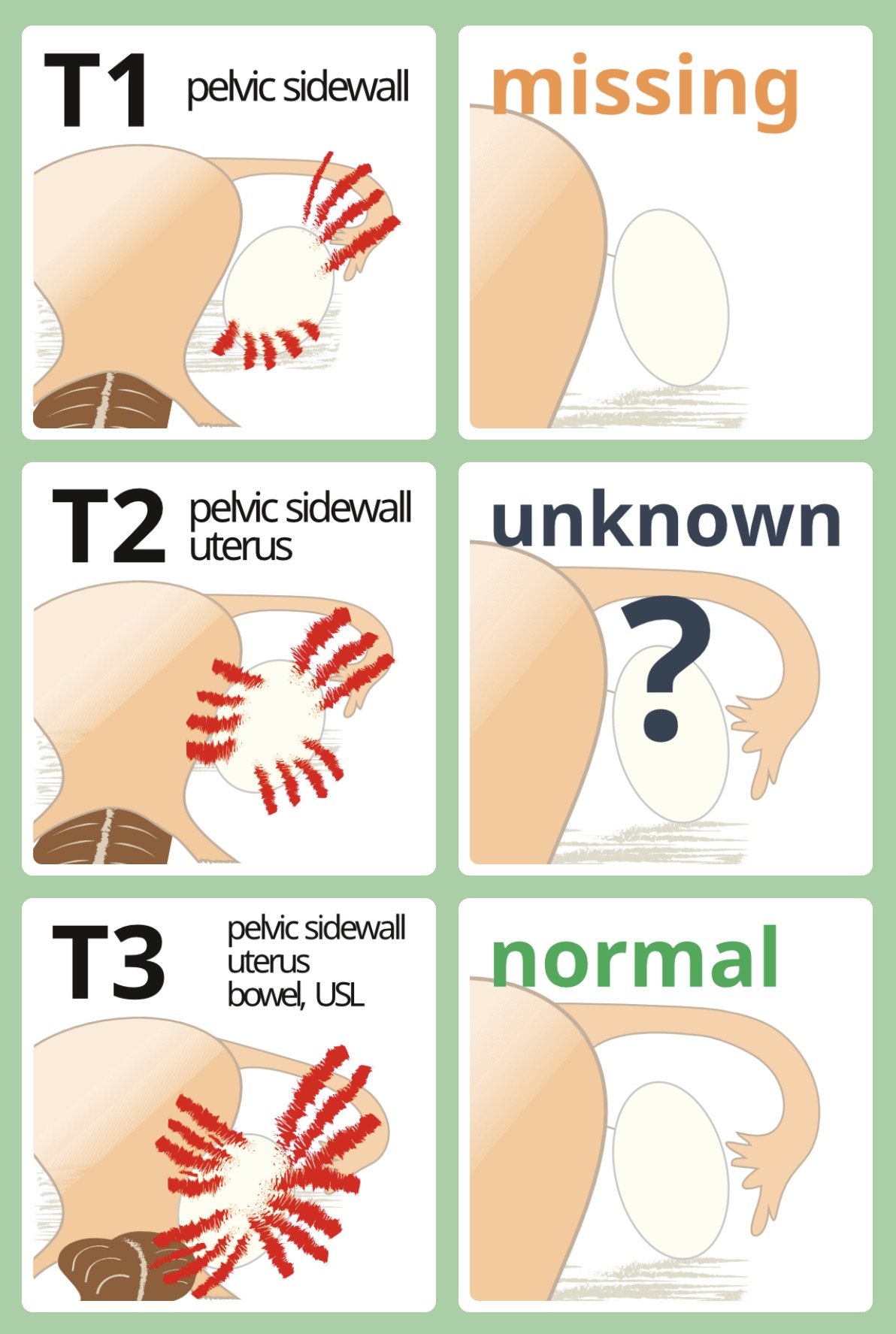


Background

The #Enzian “T” compartment classification (T1, T2, T3) describes the extent of tubo-ovarian adhesions involving the ovaries, tubes, uterus, pelvic sidewall, and bowel.
Tubal patency is currently noted as "+" (patent) or "–" (occluded), but tubal dilatation, an important determinant in case of fertility treatments, such as hydrosalpinx or hematosalpinx, is not integrated into the classification.
This section of the survey explores a proposal to explicitly code tubal dilatation using a suffix, and seeks your views on terminology and implementation.
7.In your opinion, how clinically important is it to distinguish tubal dilatation in #Enzian staging?(Required.)
8.Do you agree that the current T1–T3 classification lacks sufficient detail on tubal dilatation(Required.)
9.In the context of refining the #Enzian classification, do you support adding a suffix to indicate tubal dilatation (e.g., T2d)?(Required.)
10.If your answer in question 9 is “Yes”, would you support further subclassification based on the contents (e.g. clear fluid vs. hematosalpinx)?(Required.)
11.Do you have any additional suggestions or concerns about modifying the “T” compartment to better reflect tubo-ovarian pathology?(Required.)
12.Considering the diversity in adhesion types and tubal pathology you encounter surgically, do you believe the current T1–T3 classification sufficiently reflects disease severity and complexity? Would you support a more descriptive approach based on specific adhesion targets (e.g. tubo-ovarian, tubo-bowel, tubo-sidewall)?(Required.)
Section 3 Refining the #Enzian “C” Compartment – Rectal Endometriosis


Background

The #Enzian “C” compartment currently describes deep endometriosis involving the rectum using a size-based staging system (C1, C2, C3).
However, it does not account for the number of rectal nodules, nor does it record the distance of the lowest lesion from the anal verge, which can significantly impact surgical decision-making.
This section of the survey aims to evaluate whether coding for multiple lesions or adding a suffix (e.g. “l” for low rectal involvement) or additional variables should be introduced to improve the anatomical and surgical precision of the classification.
13.In your clinical or surgical practice, how often is lesion proximity to the anal verge a determining factor in rectal surgery planning?(Required.)
14.Do you agree that the current C1–C3 classification does not adequately capture lesion complexity in terms of anal verge proximity or number of nodules?(Required.)
15.In the context of refining the #Enzian classification, do you support adding the distance from the anal verge (in cm) of the lowest rectal lesion to the #Enzian “C” compartment scoring?(Required.)
16.If your answer in question 15 is “Yes”, would you support adding a suffix for low rectal involvement (e.g. “L” for lesions <5 cm from anal verge)?(Required.)
17.Should the number of rectal nodules (e.g. single vs. multiple) also be recorded in the classification?(Required.)
18.If your answer in question 17 is “Yes”, would you support adding a number for the lesions in the coding (e.g. C3-2)?(Required.)
19.Do you have any alternative suggestions for capturing low rectal disease or multifocality in the current #Enzian system?(Required.)
Section 4: Refining the #Enzian “FB” Compartment in # Enzian – Bladder Endometriosis Classification


Background

The FB compartment in the #Enzian system is designed to describe bladder involvement in deep infiltrating endometriosis.
A 3-stage model (FB1–FB3) is being considered in the #Enzian to further describe details of bladder lesions. However, two key questions remain regarding whether this new sub-classification is needed or not and if needed, should it be based solely on lesion size, or whether proximity to the ureteric orifice should influence staging or be separately coded.
This section of the survey outlines two possible options and seeks feedback on the clinical utility of each.
20.In your practice, how frequently does ureteral proximity affect surgical decision-making for bladder endometriosis?(Required.)
21.Do you think there is a need to change the current model of FB classification for bladder endometriosis?(Required.)
22.If you wish to change the current model, which of the following classification models do you prefer?(Required.)
23.In question 22, if your choice is option B, how should ureteral proximity be recorded?(Required.)
24.Do you have any additional suggestions regarding the classification of bladder endometriosis in the current #Enzian system?(Required.)
Section 5: Refining the #Enzian “FA” Compartment – Adenomyosis Classification within #Enzian


Background

The “FA” compartment is intended to represent adenomyosis in the #Enzian classification. Severity of adenomyosis however is not specified.
In clinical practice, adenomyosis severity can be defined by the percentage of myometrial involvement, according to the MUSA (Morphological Uterus Sonographic Assessment) criteria:
· FA1 = mild (<25%)
· FA2 = moderate (25–50%)
· FA3 = severe (>50%).

This section of the survey aims to evaluate whether classifying adenomyosis according to MUSA criteria should be introduced to improve the precision of the classification while keeping the system simple and reproducible.
25.In your practice, how frequently does specifying the severity of adenomyosis on imaging affect decision-making for management of adenomyosis?(Required.)
26.In the context of refining #Enzian classification, do you support classifying adenomyosis severity based on the percentage of myometrial involvement, as in the MUSA system?(Required.)
27.If your answer in question 26 was yes, do you support classifying “FA” grades by the percentage of myometrial involvement, as follows?
FA1 = <25% (mild)
FA2 = 25–50% (moderate)
FA3 = >50% (severe)
(Required.)
28.Do you have any suggestions for improving the FA (adenomyosis) compartment classification or its clinical application?
29.Based on your clinical and imaging experience, would it be useful to distinguish focal vs. diffuse adenomyosis within the FA compartment, given their different surgical and reproductive implications? How would you define or quantify this distinction in a reproducible way?


Thank you for completing the survey.