Find a quiet moment before you begin.

This isn't a performance review. It's a snapshot of where you consider yourself right now, across six realms of human development. Answer honestly. Answer for yourself.

When you're done, put a reminder in your calendar. Come back in one to three months and take the same survey again. Comparing the two will tell you more than either one alone.

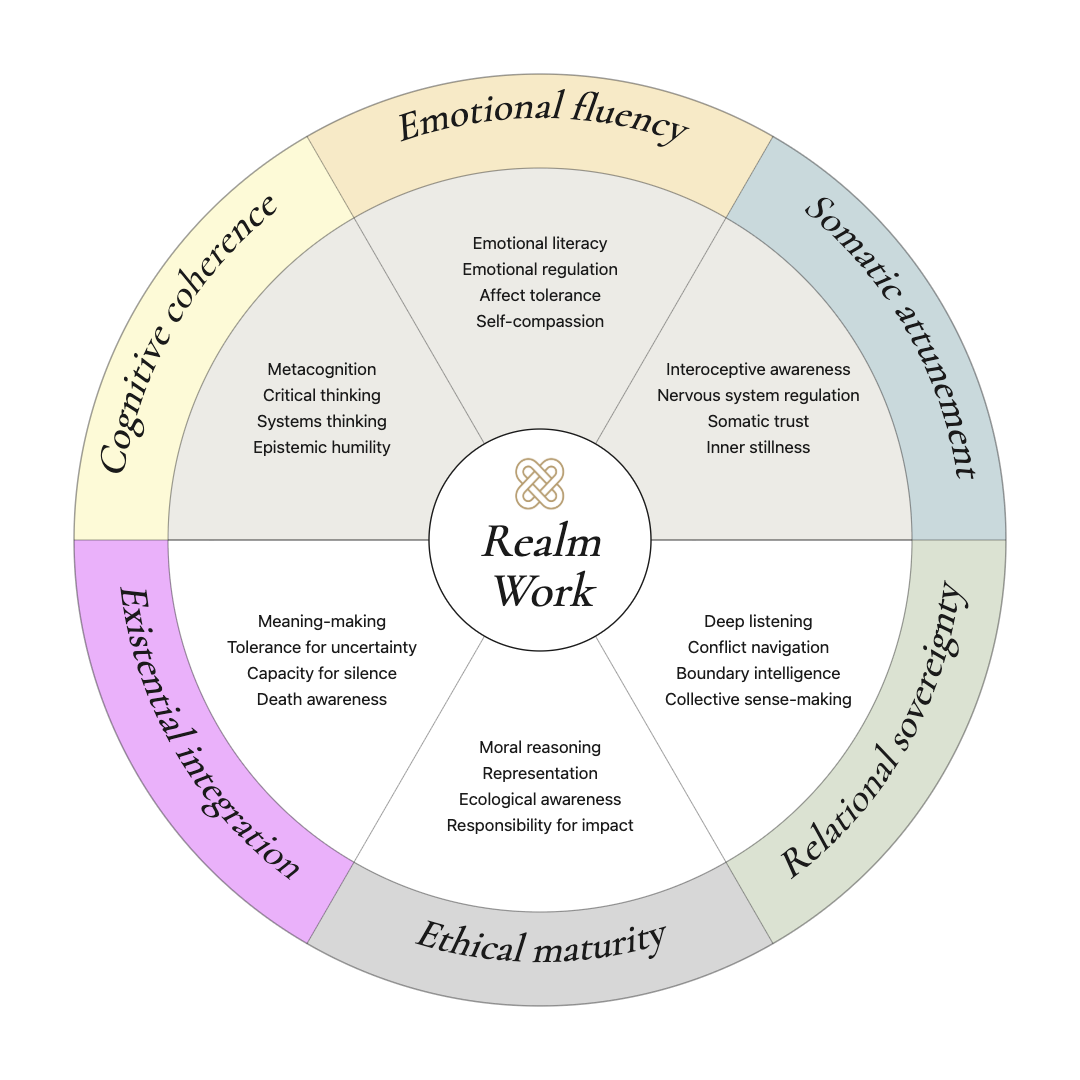
After you complete it, you'll receive the Six Realms Reflection Guide, a way to keep exploring the 24 capabilities behind these six realms.

This will take you fifteen to twenty minutes. Longer, if you let a question sit before you answer it, which is often when the good answers arrive. If you run out of time, save where you are and come back and finish the rest whenever you're ready. There's no version of this you can do wrong.

You're about to read 48 statements. For each one, notice how true it feels for you right now, not how true you wish it felt.
Question Title

1. For you to be able to receive a reflection guide for your results we ask you to leave your email address here (Required.)

First realm - Cognitive Coherence
Cognitive coherence is thinking about how you think. How you reach your conclusions, connect patterns, and relate to what you don't yet know.
Metacognition - Thinking about how you think.

Question Title

2. In situations that tend to cause the same reaction in me, I pause to notice whether I am running on a familiar thinking pattern, and whether that pattern is actually serving me. (Required.)

Question Title

3. I am aware of how my thinking changes depending on who I am with or what mood I am in, and I take that into account. (Required.)

Critical thinking

Question Title

4. When I have reached a conclusion I feel strongly about, I find myself looking for what I might have missed, rather than reasons that confirm my thinking was right. (Required.)

Question Title

5. When someone disagrees with me, I notice whether I lean toward understanding their view or explaining mine. (Required.)

Systems thinking

Question Title

6. When something keeps going wrong despite being fixed, I find myself asking what the system around it is actually designed to produce. (Required.)

Question Title

7. When I look at a difficult situation around me, I include myself as one of the factors that may be contributing to it. (Required.)

Epistemic Humility

Question Title

8. I notice when I am the most certain about something, because that is often when I am least open to what I might be missing. (Required.)

Question Title

9. I notice how often I actively seek out perspectives that are different from my own. (Required.)

Page1 / 7
 
14% of survey complete.

T