Skip to content
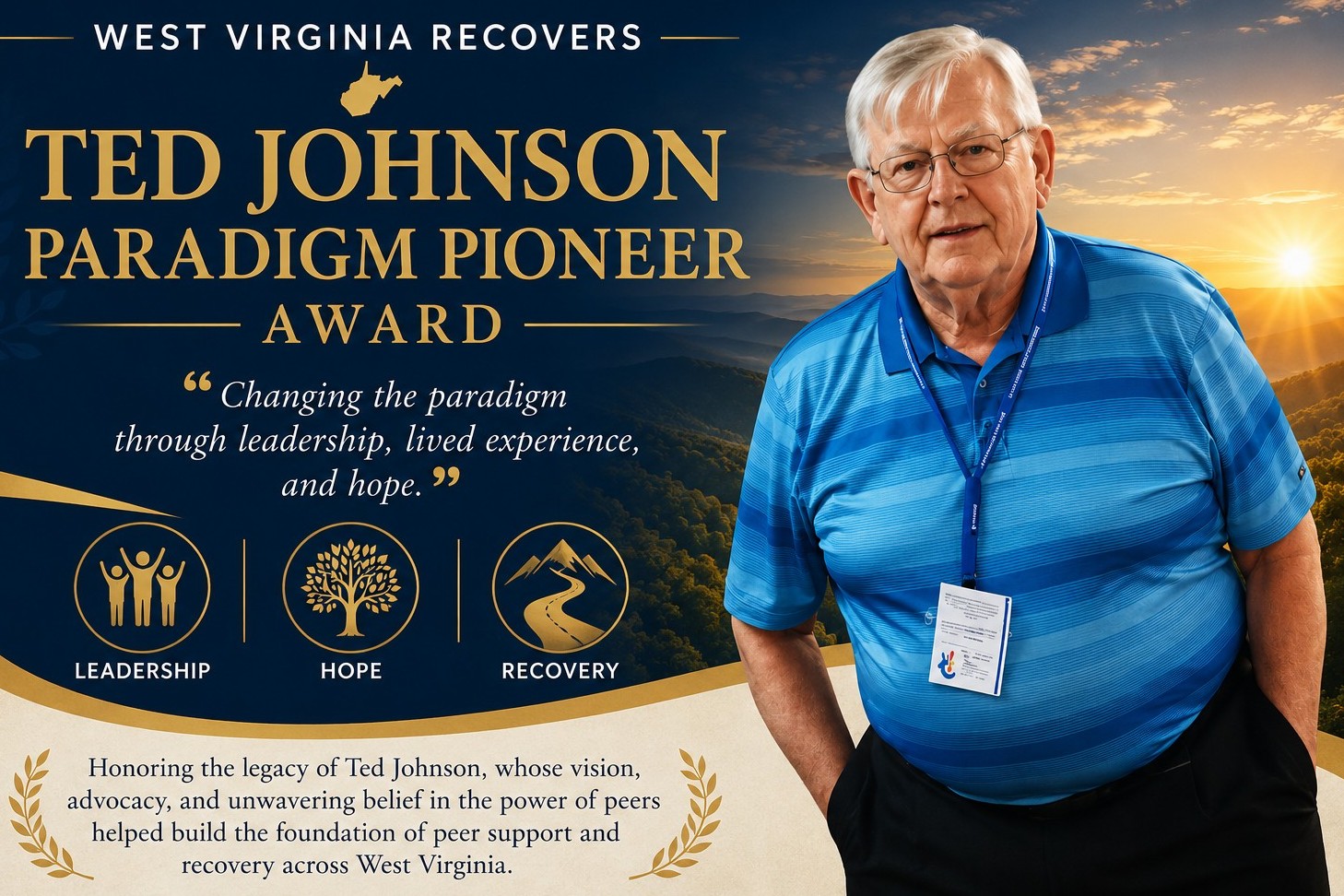
7th Annual West Virginia Recovers Ted Johnson Paradigm Pioneer Award
1.
Please vote for the nominee you feel is the best representative of a Peer in WV who embodies the character, wisdom, leadership and values of the award named after the preeminent developer of peer support, Ted Johnson. Ted helped usher peer support into West Virginia while serving the adult division for the Bureau for Behavioral Health in WV. He developed much of the structure and programs that led to the employment and practice of peer support via the development of the WV Leadership Academy for Consumers and Families, supporting Recovery Planning, ongoing advocacy, leadership, and championing the value of peers to support others and change the paradigm of healthcare delivery in WV.
About the Nominee Biographies
The biographies and personal reflections below were provided directly by the nominees as part of the West Virginia Recovers Ted Johnson Paradigm Pioneer Award nomination process. Each nominee was asked to submit a brief professional biography and respond to the following question:
"What does peer leadership mean to you, and how do you strive to embody it in your work and everyday life?"
These responses are presented as submitted to help inform your selection of this year's recipient.
o
Kayla Straight
is a dedicated professional with a passion for mental health advocacy and
community service. Currently serving as the Program Director at NAMI in West Virginia, Kayla
Straight plays a crucial role in providing training and support in mental health crisis intervention,
suicide prevention, and advocacy. She provides direct services to those experiencing mental health challenges through one-on-one peer support and facilitating support groups, while also supervising NAMI in West Virginia’s Regional Navigators throughout the state. Kayla Straight holds certifications as a PRSS-MH in West Virginia and Peer Recovery Support Specialist in Ohio. She has been a Peer Recovery Coach for 8 years. Her work extends beyond professional achievements, encompassing a commitment to their family and community. As a wife and mother of two daughters, her family manages a small homestead where they foster rescued dogs and care for lambs, goats, and chickens. She is also active in her local 4H club, an avid runner,
yogi, and bootcamp enthusiast.
Peer Leadership Reflection:
"When I think of Peer Leadership, I am filled with feelings of hope, opportunity, and community.
I have always been a lover of knowledge and education, and while I appreciate the value,
importance, and tradition of formal learning, Peer Leadership recognizes the value of lived
experience, providing perspectives that a person could never obtain in a traditional classroom.
As a Peer Leader, I see it as my personal responsibility to be a role model to others in my
community by embodying the strength, success, and growth that can be achieved through
recovery. Not only am I charged with maintaining stability in my own recovery, but in doing so, I
am also tasked with acknowledging my own shortcomings, barriers, stigma, and challenges that
can prevent forward momentum. Being a Peer Leader means being able to not just embrace, but encourage, change within oneself, the community, other peers, and the systems that support our recovery and our health. Mental
health conditions often present what can feel like an unmovable barrier to success, happiness,
and well-being for many people. I am not immune to those challenges, and I remain humbled by
the opportunity I have been afforded in my position to turn my experiences with a serious mental
illness into not just success for myself, but, most importantly, success for others who face similar
struggles. Peer Leadership is an agent of change unlike anything our state has experienced in its history. It is the ember of hope burning deep within the coal seams of West Virginia that will power our charge forward, lighting the fires of change, health, happiness, and healing throughout our state."
o
Heather Bergdall
, NCPRSS
I serve as a Peer Recovery Support Specialist with Potomac Highlands Guild, where I currently supervise the peers working within the Substance Use Disorder (SUD) Program, DCR Peers in Jails, Jobs & Hope, Mosaic, and Mobile Outreach programs.
I have a Bachelor's Degree in Criminal Justice: Professional Studies and hold National Certification as a Peer Recovery Support Specialist (PRSS), PRSS-SUD, and PRSS-MH. I am also a certified Peer Training of Trainers (TOT) Trainer and Regrounding Our Response Trainer.
"Leadership is deeply important to me, and I am passionate about supporting individuals on their recovery journey. My lived experience has been instrumental in my ability to provide hope, compassion, and empathy to those in our community. I believe in meeting people where they are, walking alongside them without judgment, and serving as a source of light during life's darkest moments. This work has profoundly shaped who I am, both personally and professionally. It continues to strengthen my commitment to recovery, empower others through connection, and advocate for a future where every individual is treated with dignity, respect, and the belief that recovery is possible."
o
Aaron Blankenship
works as the Assistant Project Director for the West Virginia Collegiate Recovery Network and serves as a PRSS SUD-MH, Recovery Coach Trainer, and Program Coordinator at Southern West Virginia Community and Technical College in Logan, WV. With years of experience in collegiate recovery and behavioral health initiatives, he combines lived recovery experience with professional expertise to advance recovery-oriented systems of care across West Virginia. He brings lived experience with the W.V. justice system and now dedicates his life to serving often-overlooked populations. Aaron is a devoted father, a loving husband, and actively engaged in his community through various civic organizations as well as a full-time volunteer in ministry at his local church and a passionate advocate for recovery. He holds an Associate of Applied Science in Business Administration from Southern West Virginia Community and Technical College and a Regents Bachelor of Arts with an emphasis in Social Work from Concord University. Aaron is currently pursuing a Master of Social Work (MSW) at Marshall University and is working toward professional social work licensure in West Virginia. A U.S. Army veteran, community advocate, researcher, and presenter, Aaron has contributed to state and national conferences on collegiate recovery, peer support, ethics, and behavioral health. His professional certifications include PRSS SUD-MH, PRSS Trainer, ASIST, SMART Recovery Facilitation, WRAP, QPR Instructor Training, Adult and Campus Mental Health First Aid Instructor Training, and numerous other credentials in recovery support, leadership, suicide prevention, trauma-informed care, and community health education. Driven by a passion for service and a belief that recovery is possible for everyone, Aaron is committed to building communities where hope, dignity, and opportunity empower individuals to achieve lasting wellness and success. "Peer leadership means that someone can be relatable and still helps to lead someone into a journey of success. Peer leaders should embody the very essence of what it means to take a lifetime of experience and bring it to bear on any given situation to assist another person in not only surviving but thriving with that support. My experiences with being an Army vet, son of an Army vet, navigating being incarcerated, reentry, recovery, and college have given me a very unique perspective about life in general. My faith in God has shaped the way that I live my everyday life in ways that I didn't know was possible. All of this being used in every encounter with coaching someone or training someone to coach someone is how that I feel that I have been able to give to people what I had lost so many times along the way. (HOPE!!) This is a most powerful asset in life. If there is one thing I intend to do in life, is to live a life that inspires HOPE in people throughout our communities both individually and collectively. "
o
William Long
I currently work as a Peer Recovery Support Specialist for Family Treatment Court in both McDowell and Wyoming counties under the Supreme Court of Appeals of WV, providing support to parents who are working towards overcoming barriers to reunification with their children in relation to CPS cases stemming from their substance use disorder. I also work actively with participants of the McDowell and Wyoming County Day Report Centers who have become justice-involved due to substance use and/or mental health disorders. I am on the board of both local and state level organizations such as McDowell County Alternative Sentencing, McDowell County HOPE Coalition, Prosper McDowell, Build Back McDowell and the Governor’s Council on Substance Abuse Treatment and Prevention for both Recovery Community and Courts/Justice-Involved Individuals. I use my position on these boards as well as share my own personal lived experience to address barriers faced by those affected by substance use or justice-involvement and advocate for community and policy changes to find solutions towards eliminating said barriers. I am certified as PRSS-SUD and PRSS-MH through WVCBAPP in addition to being certified in Recovery Coach training through the McShin Foundation. I also recently became certified as both an Adult Mental Health First Aid and QPR Gatekeeper instructor.
"Peer Leadership Reflection
As someone who found recovery outside of McDowell County, it was my goal upon returning there to make the same support, resources and opportunities I found elsewhere available in the community I will always consider home. Peer leadership to me has looked like becoming the change that I wanted to see. I have spent the last few years connecting with individuals and organizations who share the same common goal of helping individuals overcome barriers to achieve their own personal idea of recovery. Through this work, I have seen a recovery community begin to grow within McDowell County that had not been there before. My philosophy of peer leadership also depends on my willingness to show up where needed and to meet people where they are at. In order to maintain authenticity with my community and the individuals with which I work, commitment and consistency are key. My lived experience has been my greatest asset in the work that I do. Working for and with the very same programs I was once a participant of, I can speak to others from a place of understanding and truth and give hope to others that recovery is possible for them too. It is an honor to be of service."
o
Ben Shreve
is a native West Virginian originally from Morgantown and now residing in the
state Capitol of Charleston. Ben has been a state certified Peer Recovery Support
Specialist since June 2024. He currently is employed through Marshall University
Research Corporation’s West Virginia Collegiate Recovery Network as a PRSS-SUD on the
West Virginia State University campus in Institute, WV. Ben is a member of the West
Virginia Collegiate Initiative to Advance Healthy Campus Communities (WVCIA), the
National Association for Alcoholism and Drug Abuse Counselors (NAADAC), the West
Virginia State University Extension’s Substance Misuse Prevention program, and is also
involved with the West Virginia Drug Intervention Institute serving the Dunbar and Institute
communities with outreach and risk reduction education. Ben attends monthly Reentry
Council and Kanawha Communities Care Coalition meetings. Ben’s recovery date is May
1, 2021.
"Peer leadership is standing with someone through their personal recovery journey. It is
continuous support for an individual's goals and aspirations within the concept of living a
healthier, independent life. My lived experience is based around a quote Henry Ford once
said. “Experience is the thing of supreme value in life. That is true only if one is willing to
turn the past to good account”. I shape my peer approach around this quote often. Is the
experience I share valuing the individual I am speaking to? Are they truly being used to
good account for the sake of the individual. That is extremely important to me while
working as a peer. The impact I hope to have on others is ironically hope. My shared
experiences and continuous support embed an idea of hope that continuously grows for an
individual while they see the life recovery may bring."
o
Randy Harper,
I grew up in WV, but my childhood wasn't much of a childhood. I grew up with a lot of instability, loss, and addiction. Eventually, I would use these aspects of my life to help me grow into a recovery professional and peer leader. After nearly two decades of substance abuse, incarceration, overdoses, and broken relationships, I entered recovery in 2023 through Hope and Healing detox, Harmony Ridge rehab then the Kanawha Valley Fellowship Home for sober living. I was mentored by some incredible men. Through perseverance and faith, they helped me rebuild my life. Now approaching three years in recovery, I am a state certified recovery coach and trainer with WVU Medicine, pursuing national certification and further education while mentoring others in recovery, volunteering in the community, and working to establish a nonprofit to help other men and women like me. Peer leadership to me is defined very simply as leading by example. I strive to embody this in my work and everyday life by not only speaking to others about what works, what worked for me, and how I did it, but by allowing the people around me to see me put these things into action in my everyday life as well. My philosophy for peer leadership is rooted in leading by example, demonstrating integrity, empathy, and compassion through daily actions, and using our lived experience to inspire hope and help others build meaningful, lasting recovery.
o
Bobbie Nixon
is a Peer Recovery Support Specialist with focus in substance use disorder and mental health, serving through AmeriCorps. Using lived experience, she empowers women at the One Unique Recovery House in Buckhannon, West Virginia to overcome barriers, build healthy relationships, and reconnect with the community. Beneficial to the work she does, she is trained in administering Naloxone, motivational interviewing, mental health first aid, suicide prevention, trauma-informed approaches, person-first communication, and continues to build upon foundational knowledge. The Upshur County court rooms and CPS case multidisciplinary teams are well-accustomed to her presence as an advocate. She is the founder of the O.U.R. House Alumni Program and ensures a continuance of support and connection for anyone graduating the transitional living program.Bobbie is an enthusiastic co-organizer when it comes to events such as Recover Out Loud, Save a Life Day, and End the Stigma! Day. She presents herself knowing her every interaction with the public is a reflection of the recovery community, also engaging with the North Central Family Futures Coalition, Appalachian Mutual Aid Collective, and the Coalition to End Homelessness. Even at times she is unavailable to volunteer, she actively recruits for the cause.Bobbie is a mother of two, and a student at American Public University System, holding a grade point average of 4.0 and pursuing a bachelor’s degree in Legal Studies. As she succeeds in life, she brings others with her, sharing openly about how she did it so others can do it, too. Her heart is in all she does.
o
Krystal Holt
, I am a person in long-term recovery who has proudly held my WVCBAPP certification as a PRSS-SUD since 2020. I have dedicated seven years to advancing recovery services at FMRS Health Systems Inc. Since joining the organization in July 2019, I have demonstrated an impactful trajectory of leadership, beginning as a frontline PRSS for Residential Level 3.5 programs. In November 2022, I was promoted to House Manager of The Oaks, a Level 3.5 and 3.1 Men’s Program, where I successfully managed all daily operations, supervised direct support staff, and led a critical capacity expansion from 12 to 16 beds. Following the program's closure in August 2025, I transitioned into an Administrative Supervisor role, and I currently lead 12 PRSS across eight diverse programs spanning four counties, including the Quick Response Team (QRT), Regional Youth Services, Outpatient (OP), Medication-Assisted Treatment (MAT), Intensive Outpatient (IOP), Department of Corrections (DOC), Jobs and Hope and peer placements at Raleigh General Hospital (RGH). Driven by a deep
passion for this field, I have completed all requirements for my Mental Health (MH) peer credential and am awaiting final board approval. I remain focused on expanding our services through strategic community partnerships, comprehensive public outreach, and a steadfast dedication to lead by example with accountability and consistency. To me, peer leadership is the profound responsibility of turning a painful past into a purpose-driven blueprint for others. Having celebrated 15 years in long-term recovery, I navigate my current role with the distinct memory of what it was like to have no one in my corner. When I
was deep in active substance use, fighting a felony conviction, navigating a terrifying CPS removal, and trying to find my footing without a high school diploma or a driver’s license, there was no Peer Recovery Support Specialist to hold my hand or advocate for me. It was only when my probation officer and therapist held me firmly accountable that the seeds of real change
were planted. That accountability and consistency saved my life, and today, they form the cornerstone of my leadership philosophy. Becoming a certified PRSS with FMRS Health Systems Inc. gave my "bad past"; a divine purpose: to inspire, motivate, and structurally support others as they navigate those same dark spaces. I strive to embody peer leadership not by managing from afar, but by actively walking alongside my team of 12 peers across all four counties we serve. Because our specialists operate in high- intensity environments—including courts, youth services, and medical facilities—I am deeply involved in each program, attending clinical supervisions, and constantly encouraging my staff to seek clinical guidance when ethical dilemmas arise. Ultimately, the impact I hope to leave is a deeply unified community that sees the undeniable
value of lived experience!