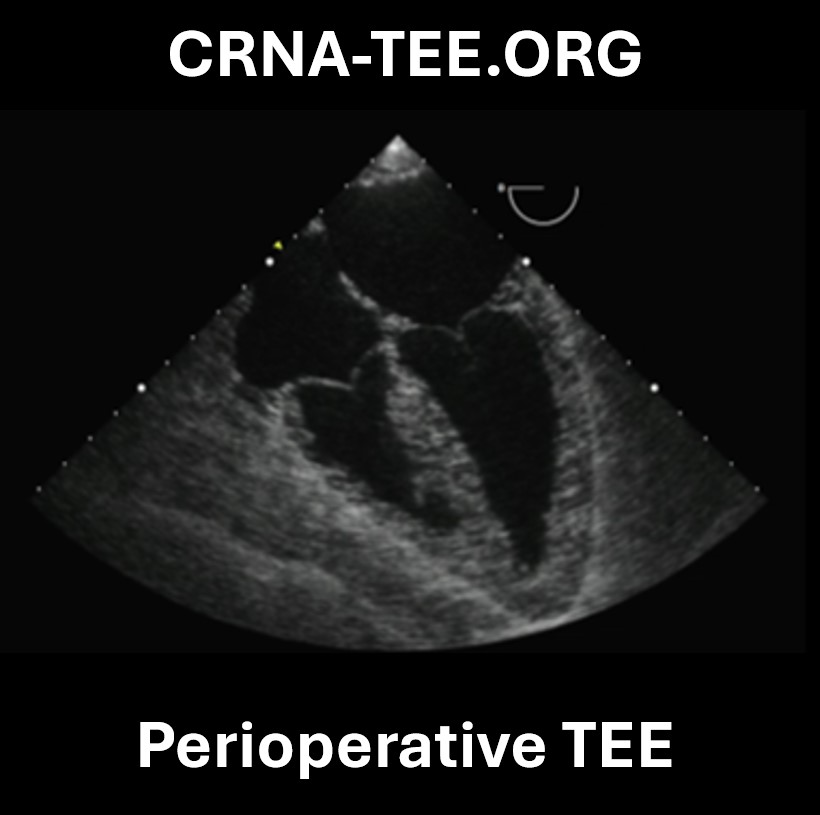
Interventional TEE Question Title * 1. Your patient post-Watchman is having undifferentiated hypotension post-deployment and your follow-up TEE demonstrates _____________ in this _________ view. HOCM; midesophageal long axis right ventricular dysfunction; midesophageal five chamber ventricular septal defect; midesophageal aortic valve short axis pericardial effusion; midesophageal four chamber Question Title * 2. Your patient (BMI 48) post-Watchman has marginal oxygen saturations rior to extubation (89%) on 100% oxygen. Your follow-up TEE demonstrates _______ in this ______ view. mitral stenosis, mideesophageal two chamber mitral regurgitation, midesophageal two chamber ventricular septal defect; transgastric short axis atrial septal defect; midesophageal bicaval Question Title * 3. After routine TAVR your patient has undifferentiated hypotension. Your follow-upTEE in the _____________ view demonstrates __________________. midsesophageal ascending aorta long axis; aortic dissection transgastric midpapillary short axis; severe mitral regurgitation midsesophageal descending aorta short axis; aortic dissection transgastric basal short axis; severe mitral regurgitation Question Title * 4. After deployment of the TAVR and the previous finding, the patient remains hypotensive and there is suspicion of acute blood loss. Which TEE view is this and what is your assessment? midesophageal descending short axis view, blood in the left chest midesophageal descending long axis view, blood in the left chest midesophageal descending short axis view, blood in the right chest midesophageal descending long axis view, blood in the right chest Question Title * 5. Prior to Watchman in a patient with a history of rheumatic fever you suspect mitral stenosis and decide to measure the gradient across the mitral valve. In this _______________ view you find the velocity to be 1.9 cm/s and the gradient across the mitral valve to be about ____________ using the simplified Bernoulli equation. midesophageal long axis; 3.8 mmHg midesophageal long axis; 7.6 mmHg midesophageal long axis; 14.4 mmHg midesophageal long axis; 15.2 mmHg Question Title * 6. Prior to transcatheter aortic valve replacement (TAVR) you are assessing the gradient across the aortic valve. Using continuous wave Doppler in the ____________________ view the velocity is 5.2 meters/second. Using the simplified Bernoulli equation, you calculate the gradient to be ____________. midesophageal five chamber; 25 mmHg transgastric long axis; 50 mmHg modified transgastric four chamber; 75 mmHg deep transgastric long axis; over 100 mmHg Question Title * 7. Complications associated with left atrial occlusion devices include atrial septal defect (ASD) pericardial effusion para-device leaks and stroke all of the above Question Title * 8. Appropriate heparin dosing for a Watchman left atrial occlusion device is typically 3000 unit heparin bolus and ACT in 30" 50 units/kg heparin bolus 100 units/kg heparin bolus 300 units/kg heparin bolus Question Title * 9. After Watchman placement you are asked to verify position based on PASS protocol. Based on the TEE images here, what is your assessment of this Watchman position/placement? mild paradevice leak, with residual left atrial appendage flow by continuous wave Doppler and color flow mapping moderate paradevice leak, with significant residual left atrial appendage flow by pulse wave Doppler and color flow mapping mild paradevice leak by color flow mapping and pulse wave Doppler no discernible paradevice leak by color flow mapping and pulse wave Doppler Question Title * 10. After placement of Watchman left atrial occlusion device, you are assessing placement of the device. What is your assessment of this TEE view after Watchman implant? normal left upper pulmonary vein flow, no paradevice leak based on color flow mapping normal right upper pulmonary vein flow, Watchman position acceptable based on PASS protocol moderate mitral regurgitation due to impingement on posterior leaflet, Watchman position not acceptable based on PASS protocol severe paradevice leak, Watchman position not acceptable based on PASS protocol Question Title * 11. Your patient has aortic stenosis with aortic valve area of 0.4 cm2. What is your assessment of this TEE imaging after TAVR placement? appropriate TAVR position with no paravalvular leak based on midesophageal long axis view low TAVR position with paravalvular leak based on midesophageal aortic valve long axis view residual aortic stenosis based on deep transgastric long axis view central aortic regurgitation based on midesophageal five chamber view Question Title * 12. After a TAVR procedure you are asked to assess gradient across the valve. What is your assessment of this TEE imaging after TAVR placement? deep transgastric long axis view with unacceptable high residual gradient (14.5 mmHg) across the new aortic valve deep transgastric long axis view with residual but acceptable gradient (14.5 mmHg) across the new aortic valve midesophageal long axis view with low residual gradient and no paravalvular leak across the new aortic valve transgastric midpapillary aortic short axis view with unacceptable high residual gradient (14.5 mmHg) across the new aortic valve Question Title * 13. After a TAVR procedure you are asked to do a TEE. What is your assessment of this TEE imaging after TAVR placement? deep transgastric long axis view with high (13.3 mmHg) residual gradient across the new aortic valve but no paravalvular leak deep transgastric long axis view with residual but acceptable (13.3 mmHg) gradient across the new aortic valve and significant paravalvular leak midesophageal aortic valve long axis view with insignificant (13,3, mmHg) gradient across the aortic valve and significant paravalvular leak transgastric midpapillary short axis view with insignificant residual (13.3 mmHg) gradient across the aortic valve and no paravalvular leak Question Title * 14. Immediately after deployment and hemodynamic recovery you decide to take a quick look with TEE at the new TAVR. What is your assessment of this TEE imaging after TAVR placement? deep transgastric view with good TAVR position and no paravalvular leak midesophageal ascending short axis view with central paravalvular leak midesophageal aortic valve short axis view with significant paravalvular leaks transgastric midpapillary short axis view with residual aortic stenosis and paravalvular leak Question Title * 15. After uneventful TAVR in your extremely hypertensive 90 year-old patient, persistent hypotension is followed by this TEE finding. What is your assessment? midesophageal ascending aorta short axis view demonstrating ascending aortic dissection midesophageal aortic valve short axis view demonstrating bicuspid aortic valve as is typical for mechanical TAVR midesophageal bicaval view demonstrating atrial septal defect midesophageal descending aorta long axis view demonstrating descending thoracic aorta dissection Question Title * 16. After TAVR you are asked to obtain metrics for gradient across the new valve. What is your interpretation of this TEE assessment? mild aortic regurgitation and significant residual gradient across the new aortic valve in this deep transgastric view moderate aortic regurgitation and residual but acceptable gradient across the new aortic valve in this deep transgastric view severe aortic regurgitation and significant residual gradient across the new aortic valve in this midesophageal aortic valve long axis view moderate aortic regurgitation and significant residual gradient across the new aortic valve in this midesophageal aortic valve long axis view Question Title * 17. Prior to Watchman implantation you are asked to clear the left atrial appendage on a patient who has been on apixaban (Eliquis) with previous TAVR. What is this structure and your assessment? left upper pulmonary vein with thrombus left atrial appendage with thrombus will need color flow mapping and pulse wave Doppler to more thoroughly assess left atrial appendage suspicious for thrombus but has been on blood thinner so safe to proceed clean atrial appendage with probably acoustic shadowing from previous TAVR Question Title * 18. Patient with bicuspid aortic valve to receive a TAVR. After deployment you are asked to verify position. What is you assessment? good placement with no paravalvular leak in this midesophageal long axis view low TAVR placement with struts impinging on posterior mitral valve leaflet in this midesophageal long axis view high TAVR placement with unacceptable residual gradient across the valve in this midesophageal five chamber view constrained TAVR due to annular plaque with severe paravalvular leak in this midesophageal long axis view Question Title * 19. What measurement for Watchman placement is indicated by the number "2"? the "lobe" reading at 45 degrees omniplane in the midesophageal left atrial appendage view the "orifice" reading at 90 degrees omniplane in the midesophageal left atrial appendage view the "neck" reading at 0 degrees omniplane in the midesophageal left atrial appendage view the "orifice" reading at 0 degrees omniplane in the midesophageal left atrial appendage view Question Title * 20. During your pre-TAVR interrogation what is your assessment in this TEE view? mitral stenosis in this transgastric basal short axis view low ejection fraction in this transgastric basal short axis view moderate aortic valve stenosis in this midesophageal aortic valve short axis view bicuspid aortic valve in this midesophageal aortic valve short axis view Done