International
Public Rescue Equipment
Survey

The International Life Saving Federation (ILS) Public Rescue Equipment (PRE) Guidelines Working Group has been established to support the development of internationally applicable, evidence-informed guidance for Public Rescue Equipment.

For the purposes of this survey, Public Rescue Equipment means rescue and flotation equipment provided for emergency public use in aquatic environments. This may include, for example, rescue tubes, rescue buoys, ring buoys, lifebuoys, throw bags, throw lines, rescue boards or other flotation / rescue aids provided for use by members of the public, first responders, lifeguards or community responders. Some examples are shown here:
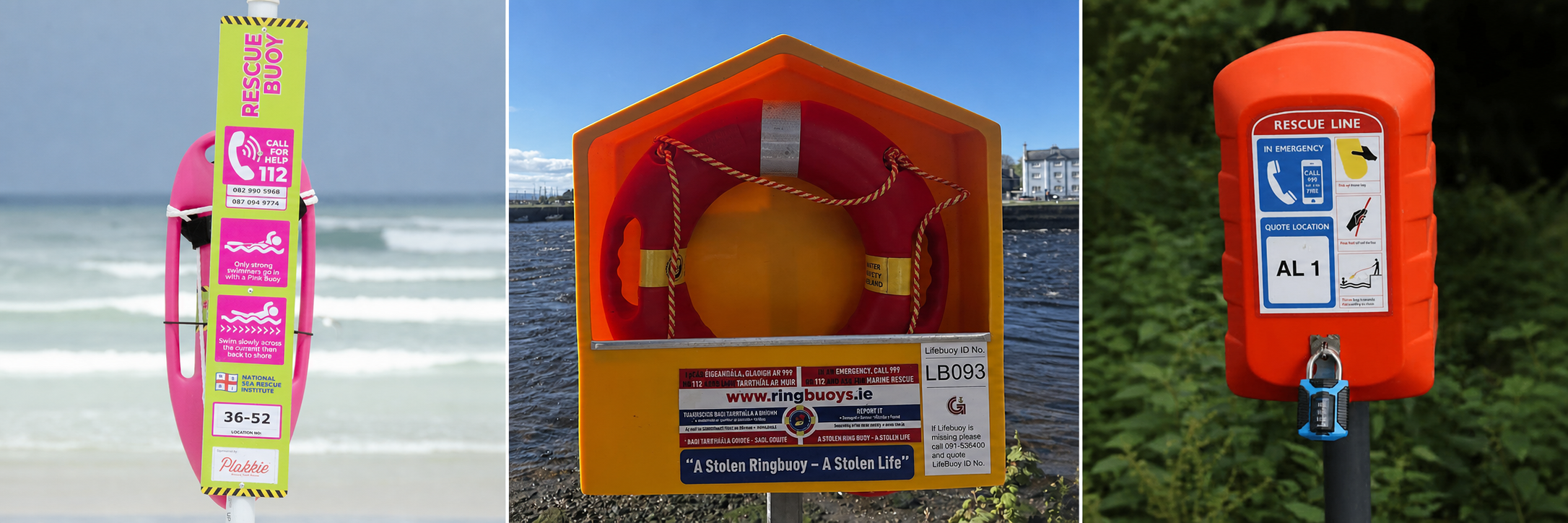


PRE should be provided and used in a way that helps bystanders assist a person in difficulty without placing themselves at unnecessary risk. This includes clear user instructions, signage and education that encourage bystanders to call for emergency help, use flotation or rescue equipment where available, avoid entering the water where possible, and consider their own swimming ability, training and the conditions before attempting any rescue.

The Working Group is considering PRE across a range of aquatic environments, including beaches and coastlines, rock platforms, headlands, jetties and harbour walls, inland still waters such as lakes, and inland moving waters such as rivers.

The aim is not to promote one product, supplier or national model, but to help organisations, authorities and risk managers make better decisions about whether PRE should be provided, where it should be located, what type may be most appropriate, and how it should be signed, maintained and governed.

This survey will help the Working Group understand:
  • how national organisations worldwide might use international PRE guidance;
  • what level of detail would be most useful;
  • what PRE programmes, guidance, research or practice already exist in different countries;
  • whether Good Samaritan laws, civil liability or legal responsibility concerns affect PRE provision;
  • whether future international standardisation, including a possible ISO standard or prescribed PRE specification, would be useful.
Background information about the ILS PRE Guidelines Working Group is available here.

The Working Group Terms of Reference are available here.

The survey should preferably be completed by someone with knowledge of your organisation’s lifesaving, drowning prevention, coastal safety, inland water safety, risk management, operations, policy or legal / governance work.

Where answers are not known, please select “Not known” rather than guessing.

This survey is not seeking legal advice and responses should not be treated as a formal legal opinion. Any questions about law, liability or Good Samaritan protection are intended to help the Working Group understand broad issues, concerns and areas where further clarification may be needed.

Responses may be summarised and reported to the ILS PRE Guidelines Working Group and relevant ILS Commissions. Individual organisations may also be contacted for follow-up information where permission is provided.

Questions about the survey may be sent to: presurvey@beachsafetyconsultants.com
This survey should take approximately 15-20 minutes to complete, or a little longer if you wish to provide links to documents, legal information, case studies or examples of existing PRE practice.
Section 1: Respondent and organisation details
1.Name of person completing this survey
2.Email address
3.Organisation(Required.)
4.Country / territory / region(Required.)
5.Your role or area of responsibility(Required.)
6.Are you responding on behalf of your organisation?(Required.)
Section 2: Current PRE position in your country
7.Is Public Rescue Equipment currently provided in public aquatic environments in your country / territory?(Required.)
8.In which environments is PRE currently provided?
9.What types of PRE are currently used? (select all that apply)
10.Who is usually involved in providing, funding, installing and maintaining PRE in your country? (Please tick all that apply. More than one organisation may be involved in each activity).
Provides / owns PRE
Funds PRE
Installs PRE
Inspects / maintains PRE
National lifesaving organisation
Regional / state / provincial lifesaving organisation
Local authority / municipality / council
Land manager / landowner
Emergency services
Coastguard / maritime agency
Parks / conservation agency
Community group / charity / NGO
Private business / tourism operator
Schools / education providers
Not-for-profit foundation
Not sure
11.Does your country / organisation have national or regional PRE guidance, policy, standards, specifications or decision tools?(Required.)
12.Please describe and if possible provide web links to any relevant PRE documents, photographs, guidance, decision tools, research, signage examples or case studies.
Section 3: Existing or emerging best practice
13.Are there any examples of PRE good practice from your country that the ILS PRE Guidelines Working Group should consider?(Required.)
14.Please describe and if possible provide web links to the good practice example(s).
15.Are there any examples of PRE that have not worked well, created problems, or raised concerns in your country?(Required.)
16.Please describe the issue or concern.
Section 4: Legal liability, Good Samaritan protection and governance
17.To the best of your knowledge, does your country / territory have Good Samaritan law or similar legal protection that may apply to bystanders attempting a rescue?(Required.)
18.To the best of your knowledge, does any Good Samaritan or similar protection also apply to organisations, land managers, local authorities or others who install / provide PRE?(Required.)
19.Are concerns about civil liability, legal responsibility or duty of care a barrier to PRE being installed or promoted in your country / territory / region?(Required.)
20.Are you aware of any legal action being taken as a result of the installation of PRE and it failing, or for any other reason?(Required.)
21.Which legal or governance issues are most relevant in your country?(Required.)
Section 5: What ILS guidance should contain
22.How would your organisation most likely use international ILS PRE guidelines? (select all that apply)(Required.)
23.What level of detail would be most useful for your organisation?(Required.)
24.How prescriptive should ILS PRE guidance be at this stage?(Required.)
25.Should the guidance be designed differently for different country contexts?(Required.)
26.Which format would be most useful?(Required.)
Section 6: Future standardisation and ISO
27.Would your organisation support ILS exploring a longer-term pathway toward more formal international standardisation of PRE, potentially including an ISO standard or similar international specification?(Required.)
28.Relating to PRE specifically, what would be most useful to standardise internationally, if evidence and consensus support this in the future?
29.What concerns, if any, would your organisation have about a future ISO standard or prescribed PRE specification?
30.Please provide any further comments on future international standardisation, including any role ILS should or should not play.
Section 7: Follow-up and document sharing
31.Would your organisation be willing to share documents, photographs, case studies, research, decision tools, signage examples or other materials with the ILS PRE Guidelines Working Group?(Required.)
32.Would your organisation be willing to take part in a follow-up discussion or interview if the Working Group needs further information?
33.Please provide the best contact details for any follow-up.
34.Final comments
Prompt text:

Please add anything else you think the ILS PRE Guidelines Working Group should consider when developing international PRE guidance.